Support Gansey Nation -
Buy Gordon a cuppa!
Many, many thanks to those of you who have already contributed!
|
 In the Caithness Archives we have a fascinating series of Wick harbourmaster’s logbooks dating from the 1860s, recording what the weather was like each day and what was happening down at the harbour. (I’ve just started posting some from August 1871 on the archives’ Facebook page, an entry a day.) In the Caithness Archives we have a fascinating series of Wick harbourmaster’s logbooks dating from the 1860s, recording what the weather was like each day and what was happening down at the harbour. (I’ve just started posting some from August 1871 on the archives’ Facebook page, an entry a day.)
 Although the fishing season was drawing to an end in August, it’s still interesting to read about the time when so many herring were landed the herring gutters couldn’t process them all, and the rest had to sit overnight on the quay in the pouring rain; or when whales were seen on all sides of the bay, as opposed to the oil rigs and wind turbines which make up the view today. Although the fishing season was drawing to an end in August, it’s still interesting to read about the time when so many herring were landed the herring gutters couldn’t process them all, and the rest had to sit overnight on the quay in the pouring rain; or when whales were seen on all sides of the bay, as opposed to the oil rigs and wind turbines which make up the view today.
This has sent me researching into just how the fishing industry operated in Scotland at this time; and since these were the guys and gals whose jumpers we celebrate on this site, and because it’s a glimpse into a lost world, I thought I’d share it with you this week.
 The whole thing starts with the “fishcurers”. I used to think these were the people who actually preserved the herring, but in fact they were the merchants who really ran the industry (the ones in the photos with bowler hats and jackets and their fists on their hips looking prosperous). These curers would bid at a public auction for a curing station in the harbour to operate from, usually a yard in the open air. When the season started, this is where they’d arrange rows of empty barrels and salt, and the gutting troughs, called farlans. The whole thing starts with the “fishcurers”. I used to think these were the people who actually preserved the herring, but in fact they were the merchants who really ran the industry (the ones in the photos with bowler hats and jackets and their fists on their hips looking prosperous). These curers would bid at a public auction for a curing station in the harbour to operate from, usually a yard in the open air. When the season started, this is where they’d arrange rows of empty barrels and salt, and the gutting troughs, called farlans.
Each fishcurer would then contract a number of skippers of boats to fish for them for the season, guaranteeing to pay them a fixed fee for a certain quantity of herring. A curer might engage a skipper to provide him with, say, 200 crans of fish (a cran being a measure of about 1,000 herring) at so much a cran. The skippers would then find their own crews, usually family members, or unemployed men who descended on the harbours every season looking for work.
 This week’s outing: Hill o’ Many Stanes, Mid-Clyth The curers would also contract teams of women to gut and pack the landed fish (the famous “fisher lassies”). Just like the skippers of the fishing boats, a curer would make a contract with a woman, and she would then be responsible for recruiting another two women to make up her team, each team consisting of two gutters and a packer.
I don’t know how it worked in other places, but in Wick the whole town ran on credit. Once the initial contracts were made, little money changed hands until the final reckoning at the end of the season, and shops supplied the gutters and the boat crews with everything on account. The skippers were given a “cran token” for every cran they supplied to their curer: when it was all over, the tokens were added up and the curers paid the skippers in cash.
The boats would go out in the evening and cast their nets; next day they’d haul them in and return to port with the catch, which they’d deliver to the stations of their contracted curers. Boys would be sent running to summon the women from their lodgings if they weren’t already waiting at the quay. The fish would be tipped into the farlans, where they were gutted by the women and dropped into baskets arranged by size. The packer would pack the gutted herring into barrels layered with salt, and then the barrels would sit for a week to let the salt dehydrate the fish. They were then opened and any shrinkage would be topped up with fresh fish and brine, and finally resealed ready to be shipped off for export by the curers.
After c.1880 the system of contracts for fishermen was replaced by auctions, and each boat as it came in would send up a basket to the auction house as a sample. The curers would bid for it, and the catch was then landed at the curing station of the highest bidder.
 Hill o’ Many Stanes The Wick herring season lasted from June to August/September, and then the crews would be paid off, and the Highlanders and Islanders would go home, or move on to other parts of the country, other harbours, to catch the shoals in other grounds. It must have been an extraordinary life, following the herring; and the town, which more or less doubled in population during the summer months, must have been a wild, exhilarating, volatile place—not to mention seagull heaven.
Sometimes I walk along the deserted quays, and think of the old photographs, and try to visualise the harbour so crammed with boats (up to 400 at one time) that you could walk from one side to the other without getting your feet wet—unless a boat was a bit leaky—but it’s impossible now. The fishermen and their nets are gone, as are the women, knitting in the sun and waiting for the fleet to come in, and laughing as they talk. Only the seagulls remain. (Ah, well; as they say, nostalgia isn’t what it used to be.)
Next week: normal service is resumed, as I will (hopefully) have finished the gansey for the Reaper, and will be trying to recreate life in Victorian Wick by getting roaring drunk on whisky which I’ve obtained on credit…
 You know the saying that travel broadens the mind? Well, in my case it may do, but it also raises the blood pressure, increases stress levels and shortens my life expectancy. Much of this is caused by staying in hotels, of course. The room I had in the hotel in Inverness last week was so narrow I touched all four walls every time I breathed in: lying in the bed was like being digested by a boa constrictor, or buried alive in a child’s coffin. Then the guy next door came in noisily at 1.30 in the morning, and got up and left noisily at 5.00; the walls were so thin I could hear his nose hairs rustling as he slept. You know the saying that travel broadens the mind? Well, in my case it may do, but it also raises the blood pressure, increases stress levels and shortens my life expectancy. Much of this is caused by staying in hotels, of course. The room I had in the hotel in Inverness last week was so narrow I touched all four walls every time I breathed in: lying in the bed was like being digested by a boa constrictor, or buried alive in a child’s coffin. Then the guy next door came in noisily at 1.30 in the morning, and got up and left noisily at 5.00; the walls were so thin I could hear his nose hairs rustling as he slept.
Dornoch Firth, not to be confused with a hotel in Inverness There’s this theory that the universe will expand to a certain point, then collapse back, there’s a big bang and everything repeats, again and again, eternally and for ever. There are many reasons why I don’t want this to be true, but mostly because it will mean endlessly reliving that night in Inverness, back and forth, until the end of time and space, an infinity of sleepless 5.00am’s.
I spent part of last week’s holiday with my parents at Reid Towers, our ancestral mansion in Northamptonshire overlooking the Grand Union Canal. South Northants really is a lovely county, a patchwork of fields draping the landscape like an embroidered quilt, charming villages of Cotswold stone, all ivy-covered pubs and cricket on the village green, and everywhere herds of solicitors and doctors, the only ones who can afford to live there, ravaging the crops like wild deer (time for another cull, you say? Pass me my twelve bore). But it still feels like home to me.
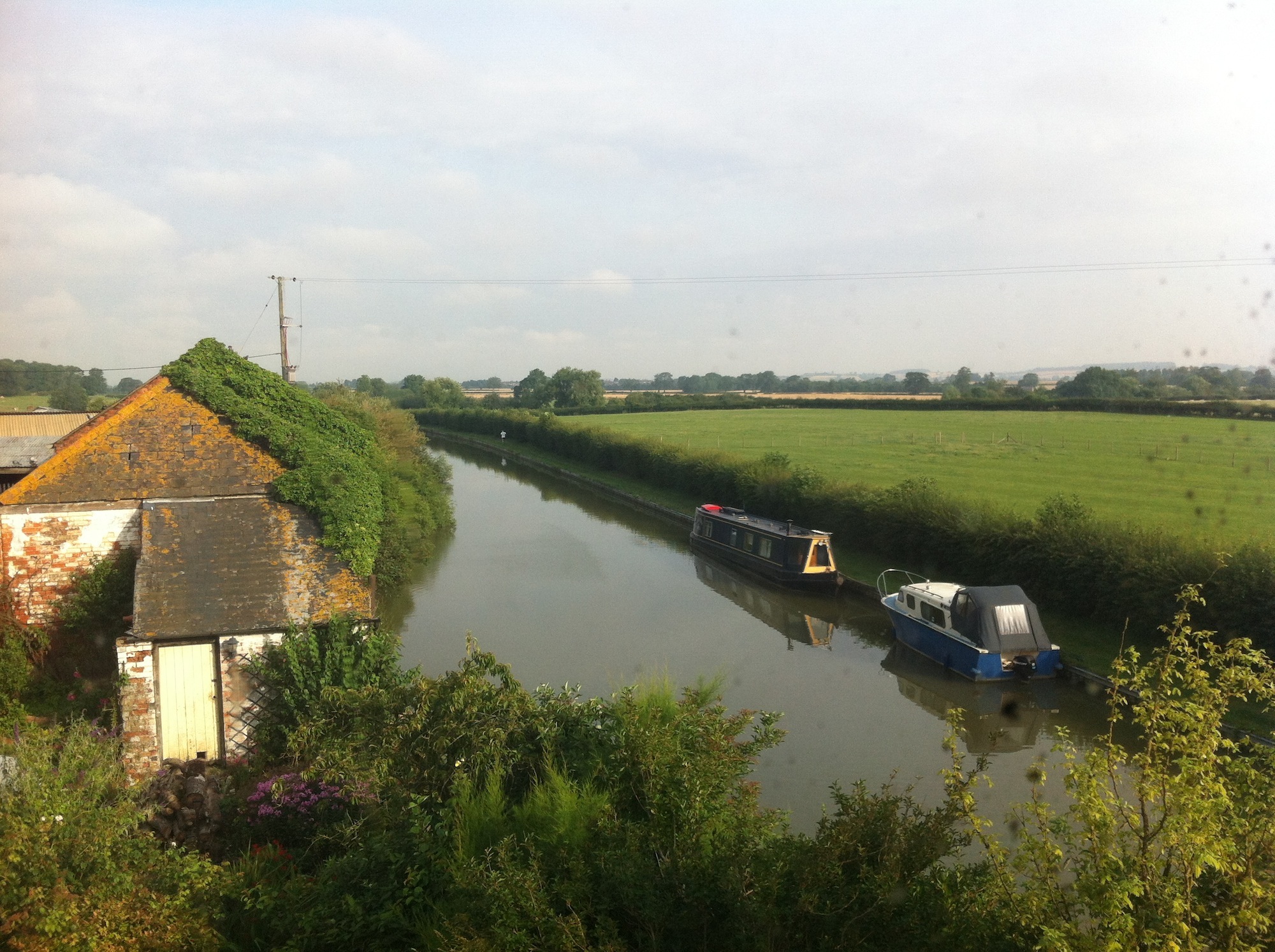
The Grand Union Canal from my bedroom window Chez Reid The town of Northampton itself, though, is sadly an urban wasteland of post-apocalyptic desolation, where hollow-eyed survivors stagger from the ruins after dark (not zombies, of course, for as everyone knows, zombies feed on brains, and the last one in Northampton starved to death 20 years ago).
Northampton made the schoolboy error of supporting Parliament in the Civil War, so when Charles II was restored to the throne he—rather petulantly, it’s always seemed to me—had the castle torn down, starting a tradition of destruction carried on by the Luftwaffe and subsequent town planners. Retracing my childhood in the town is now about as hard as working out how medieval people lived and already involves more archaeology than history (I know I’m getting old, but really: this is my childhood, people).
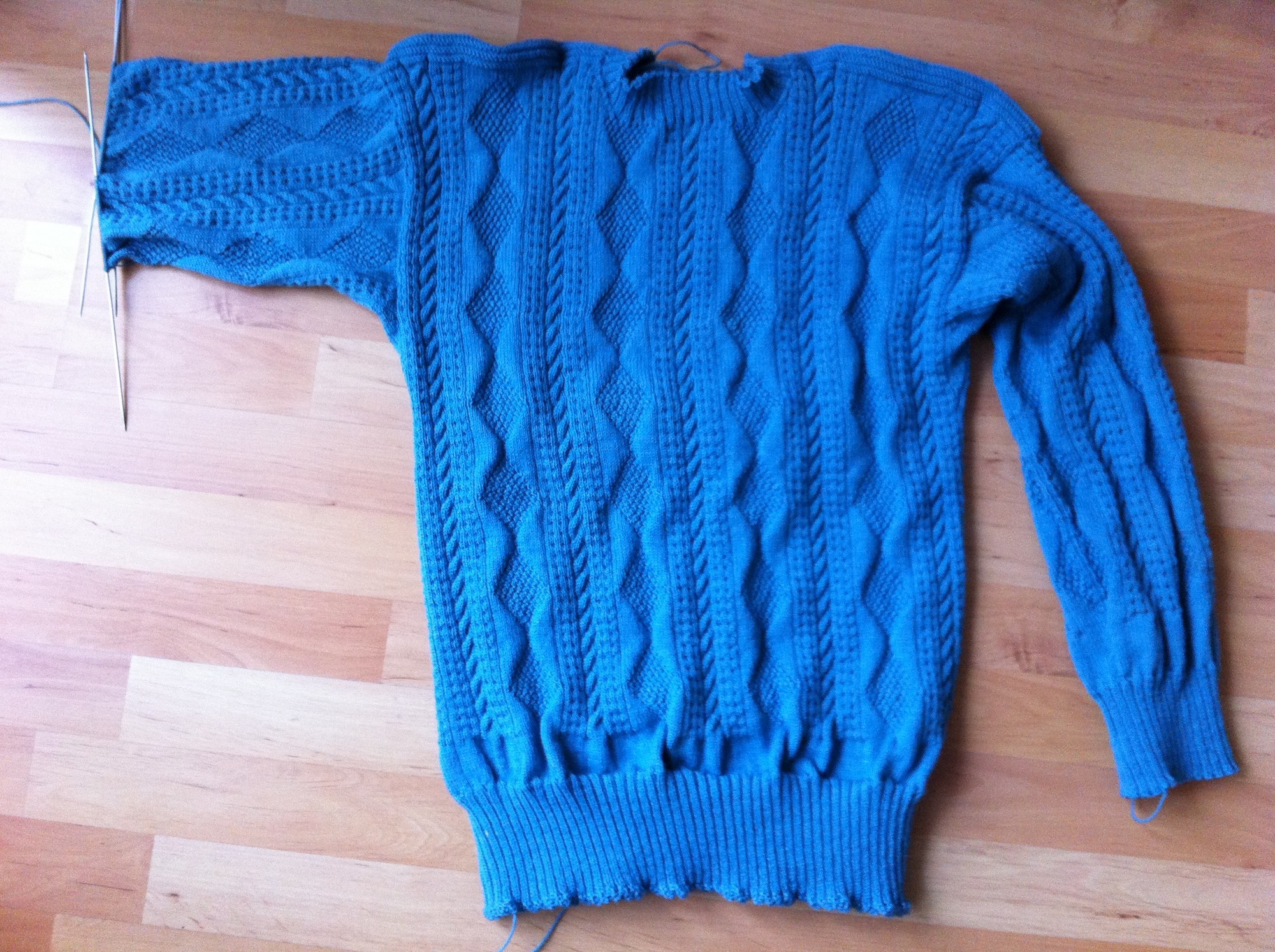
I left my knitting behind, as I usually do on these trips, partly because I’m self-conscious, but mostly because it’s so big and unmanageable now it’s like holding a drunken sheep with a fever on your lap. And anyway, it was just too hot down south (at one point I even contemplated rolling up my shirtsleeves, but recollected in time that there were ladies present, and forbore). Still, I’ve managed another few inches since last time, and am still on track to finish the gansey by the end of the month.
My Victorian detective novel The Cuckoo’s Nest continues to sell well on Amazon, selling more in a month than some of my books ever have, so thank you to all who’ve downloaded it. I guess crime, as they say, really does pay.
Margaret comes back from serving her time in a Turkish prison, correction, “holiday”, next week, when normal service will be resumed—by which I mean the blog will have images that actually vaguely resemble their subjects. Meanwhile I’m off to catch up on my sleep, now my travels are done: I think, all things considered, I’ll keep my mind safely narrow in future.
 First of all, I should apologise for the sudden drop in quality of this week’s pictures and blog generally. This is not, as you would suspect, because we have outsourced the blog to Taiwan; but because Margaret has a court order requiring her to be allowed to go away and enjoy herself at least once a year, which seems only fair, and so she’s off to the Continent for a few weeks. First of all, I should apologise for the sudden drop in quality of this week’s pictures and blog generally. This is not, as you would suspect, because we have outsourced the blog to Taiwan; but because Margaret has a court order requiring her to be allowed to go away and enjoy herself at least once a year, which seems only fair, and so she’s off to the Continent for a few weeks.
She’s taken her camera with her, so it’s just me and my iPhone: which is why the gansey looks as if it’s suddenly turned aquamarine overnight, as if cursed by an evil godmother who’s also colour-blind.
After finishing off the first cuff I spent a couple of days in denial, refusing to pick up the stitches around the other armhole like a 12 year-old who won’t get out of bed because there’s a test at school. I’m trying to develop a scale to reflect my reluctance to pick up stitches: at the moment it rates slightly worse than doing the ironing, but better than a trip to the dentist.
How so be it, I finally manned up and of course it wasn’t so bad, and now I’m on the home straight, with the finish line in sight—sometime around the end of August, hopefully.
It’s been a hard old week at work: there’s a room in an empty industrial unit in Wick that’s been used to store old Council records which has to be cleared, so, with my colleague on holiday just now, I’ve been doing an hour there each morning, sorting what I need to keep and carting it to the office, then going home for a shower and a change of clothes, and then back to work again to open up for the public.
I know that, from reading these blogs, you’d think archives was a glamorous, exciting world of fast cars and high living. And, of course, so it is, normally (only with old records in place of the cars). But sometimes, like this week, just me in an abandoned old building, full of dirt and darkness and spiders and strange noises, it’s kind of squalid.
I remember once when we were rescuing some old records from a shed in Wales and another colleague reached up to pull down a box from a shelf, and a spider ran over his hand and disappeared up his sleeve. The results were fascinating to watch, really: first he sort of spasmed, like someone touching an electric fence; and then he began to wriggle, as if showing what a speeded up time-lapse film of a mime artist might look like—all the time making high-pitched squeals like a pig being sucked into space through an airlock very slowly.
Archivists: the unsung heroes. (Where’s my movie, Clint?)
Did I say it was flat up here? My Victorian murder mystery The Cuckoo’s Nest continues to do pretty well on Amazon, better than any of my other books at the same stage, in fact: I guess crime really does pay, as the saying goes. So thanks to everyone who’s downloaded or bought it. Hope you like it. I’m not going to write a sequel—I think my poor characters have earned the right to an undisturbed happy ending—well, I say happy—but I may write another Victorian mystery if this one continues to do well.
There won’t be a blog next week: as I shall be away myself, feeling that I rather deserve a holiday at this point, and I won’t be taking my knitting. I’m heading south to England, where, like Paul Simon, my heart lies, or, if not my heart, the memory of my youth and full head of hair (“Ou sont les follicles d’antan?”, as François Villon once said). So the next blog will probably be live for 11 August.
See you then!
 First of all, many thanks to everyone who downloaded a copy of my novel The Cuckoo’s Nest when it was on a free promotion on Amazon last week. The book had some 2,000 downloads, sending it rocketing to number 1 in the free historical mysteries chart, and number 48 in the overall Amazon free chart. (Remember, if you’re one of those 2,000, and you enjoyed it, please add a review, however short; and of course, if you hated it, please have the good taste to keep it to yourself…) First of all, many thanks to everyone who downloaded a copy of my novel The Cuckoo’s Nest when it was on a free promotion on Amazon last week. The book had some 2,000 downloads, sending it rocketing to number 1 in the free historical mysteries chart, and number 48 in the overall Amazon free chart. (Remember, if you’re one of those 2,000, and you enjoyed it, please add a review, however short; and of course, if you hated it, please have the good taste to keep it to yourself…)
 Summer came to Caithness this weekend—cloudless skies, a flat calm on the ocean, breeze warm as a lover’s sigh—and brought with it the County Show, all the way to the bottom of our garden. You see, we live in a cul-de-sac which ends in fields, and across the road from us is another field, usually occupied by sheep, sloping gently to the river. My rather bucolic walk to work takes me down a lane through these fields and along the river, and in ten minutes I’m at the library (unless I get into a philosophical argument with a seagull, in which case anything goes). Summer came to Caithness this weekend—cloudless skies, a flat calm on the ocean, breeze warm as a lover’s sigh—and brought with it the County Show, all the way to the bottom of our garden. You see, we live in a cul-de-sac which ends in fields, and across the road from us is another field, usually occupied by sheep, sloping gently to the river. My rather bucolic walk to work takes me down a lane through these fields and along the river, and in ten minutes I’m at the library (unless I get into a philosophical argument with a seagull, in which case anything goes).
 Now the field was full of tents and marquees, for all the world as if Henry VIII had decided to make a state visit to Wick—always assuming Henry’s courtiers also drove tractors and enjoyed playing whack-a-mole. In fact, I hadn’t really appreciated the scale of the operation until I threw open the curtains on Saturday morning in a state of quite spectacular undress and found myself looking down on what must have been half the population of Caithness, and at the same time unwittingly recreated that scene in Life of Brian when our eponymous hero exposes himself—literally—to his followers. Now the field was full of tents and marquees, for all the world as if Henry VIII had decided to make a state visit to Wick—always assuming Henry’s courtiers also drove tractors and enjoyed playing whack-a-mole. In fact, I hadn’t really appreciated the scale of the operation until I threw open the curtains on Saturday morning in a state of quite spectacular undress and found myself looking down on what must have been half the population of Caithness, and at the same time unwittingly recreated that scene in Life of Brian when our eponymous hero exposes himself—literally—to his followers.
I’m not really a fan of agricultural shows, feeling about them much the way the great Liverpool football manager did about his local rivals: “If Everton were playing at the bottom of my garden, I’d draw the curtains.” This was a bit like being subjected to psychological warfare by the American army, with pounding rock music and distorted screaming over the tannoy—the overall effect that of a cat suspected of heresy being tortured by the Inquisition to a soundtrack of Neil Diamond.
 On the gansey, I’m nearly at the end of the first sleeve. The arm is about 18-18.5 inches long, and I decreased by 10% into the cuff. I plan to make the cuffs 3 inches long, and not make them double-length this time, since I’m not knitting the gansey for anyone in particular. Then it’s on to the second sleeve, and the whole finished by the end of August. Hopefully. On the gansey, I’m nearly at the end of the first sleeve. The arm is about 18-18.5 inches long, and I decreased by 10% into the cuff. I plan to make the cuffs 3 inches long, and not make them double-length this time, since I’m not knitting the gansey for anyone in particular. Then it’s on to the second sleeve, and the whole finished by the end of August. Hopefully.
Speaking of ganseys, I got confirmation this week that I’ve wasted my life when Margaret found an add on Pinterest for made-to-order ganseys. The price per gansey? A mere £1,250, or $1,900. But then, I suppose, what is a reasonable price for a hand-knitted gansey…?
  After our appetites were whetted last week by the sight of puffins up at Duncansby Head, we decided to explore the large puffin colony up the coast a few miles past Dounreay on the Caithness-Sutherland border. This is at a strange and beautiful place called Drumholllistan. After our appetites were whetted last week by the sight of puffins up at Duncansby Head, we decided to explore the large puffin colony up the coast a few miles past Dounreay on the Caithness-Sutherland border. This is at a strange and beautiful place called Drumholllistan.
 It’s wild country up there, a broad, flat expanse of squishy peat and moss stretching to the coast. You have to leave the car behind and follow a ghost of a track for half a mile or so across the moor, through white cotton grass and flowering purple heather, adders and giant slugs, past the bones of cattle and members of earlier expeditions lying bleaching in the sun—or at least you would, if the sun ever shone in Caithness—until you reach the cliffs, and a deep cleft opens up in the earth, and there’s a hidden cove, and a rocky beach, and there below you is what I like to think of as the Puffinarium. It’s wild country up there, a broad, flat expanse of squishy peat and moss stretching to the coast. You have to leave the car behind and follow a ghost of a track for half a mile or so across the moor, through white cotton grass and flowering purple heather, adders and giant slugs, past the bones of cattle and members of earlier expeditions lying bleaching in the sun—or at least you would, if the sun ever shone in Caithness—until you reach the cliffs, and a deep cleft opens up in the earth, and there’s a hidden cove, and a rocky beach, and there below you is what I like to think of as the Puffinarium.
 Snake in the Grass: an adder There’s a moment where you feel cheated, and say, “But where are all the birds? I thought this was supposed to be Puffin Central!” And then you look more closely and see the grassy slopes frothing like yeast with hundreds of puffins, and all those things you took to be floaters in your eye are really puffins soaring in the breeze like penguins who’ve discovered how to paraglide.
 Embiggen for a better view: those little black dots are puffins. Lots of ’em. We scrabbled about two-thirds down the cleft, stopping only when we remembered we’d have to climb back up, and sat and stared through binoculars at the oblivious puffins, which reminded me of one happy evening I spent back in Edinburgh when the students across the road forgot to close their curtains.
(By the way, have you ever noticed a resemblance between a puffin’s head and the helmet of an Imperial Stormtrooper in Star Wars? Coincidence? I think not.)
 I have a new book out, just published on Amazon kindle. It’s called The Cuckoo’s Nest, and it’s a Victorian murder mystery (not fantasy this time), set during the building of the Elan Valley dams in Radnorshire in the 1890s. I wrote the first draft 10 years ago, and have been honing it on and off ever since. It’s probably the book I’m most proud of, my love letter to my beloved Mid Wales, and if you’re curious it will be on a free promotion this week, ending Friday. I have a new book out, just published on Amazon kindle. It’s called The Cuckoo’s Nest, and it’s a Victorian murder mystery (not fantasy this time), set during the building of the Elan Valley dams in Radnorshire in the 1890s. I wrote the first draft 10 years ago, and have been honing it on and off ever since. It’s probably the book I’m most proud of, my love letter to my beloved Mid Wales, and if you’re curious it will be on a free promotion this week, ending Friday.
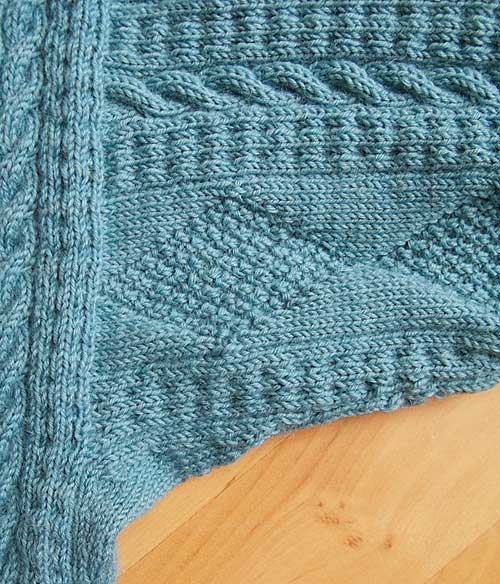
In gansey news, I’m making good progress down the first sleeve. Now I’m past the gusset I’m decreasing 2 stitches on every 7th row, the decrease rows aligned with the cable rows. And as ever, I’m anxious that the sleeve isn’t too wide and baggy, or too narrow and tight. I plan to maintain the pattern for 5 diamonds, or about 15 inches, and leave the rest of the sleeve plain to the cuff.
-

-
Dactylorhiza maculata –
Heath Spotted Orchid
-

-
Iris pseudacorus – Yellow Flag Iris
-

-
Erica cinerea – Bell Heather
 Finally, you remember I mentioned our superabundance of spiders the other week? Yesterday I opened the cupboard to find a great black spider next to the jar of peanut butter: for a few moments we were both too surprised to react—the spider assuming the nonchalant air of one sent by other spiders just to see what sort of additives Tesco were putting in their peanut butter nowadays—before I remembered which of us was the 6-foot mammal, and evicted the blighter. Finally, you remember I mentioned our superabundance of spiders the other week? Yesterday I opened the cupboard to find a great black spider next to the jar of peanut butter: for a few moments we were both too surprised to react—the spider assuming the nonchalant air of one sent by other spiders just to see what sort of additives Tesco were putting in their peanut butter nowadays—before I remembered which of us was the 6-foot mammal, and evicted the blighter.
Well, Margaret has decided to fight back and has knitted her own giant cobweb. At least, I assume that’s what it is: she did say something about it being a shawl; but when she’s on holiday I plan to stretch it over the kitchen cupboards, smear it with glue and give the little beggars a taste of their own medicine…
|
Recent Posts
-
Wick – Double Diamonds: Week 8, 22 June
-
Wick – Double Diamonds: Week 7, 15 June
-
Wick – Double Diamonds: Week 6, 8 June
-
Wick (Double Diamonds): Week 5 – 1 June
-
Wick (Double Diamonds): Week 4 – 25 May
-
Wick (Double Diamonds): Week 3, 18 May
-
Wick (Double Diamonds): Week 1, 4 May
-
Red Hood: Week 5, 27 April
-
Red Hood: Week 4, 20 April
-
Red Hood: Week 3, 13 April
-
Wick (Moss & Diamonds): Week 17, 6 April
-
Wick (Moss & Diamonds): Week 16, 30 March
-
Wick (Moss & Diamonds): Weeks 13-15, 23 March
-
Wick (Moss & Diamonds): Week 12, 2 March
-
Wick (Moss & Diamonds): Week 11, 23 February
-
Wick (Moss & Diamonds): Week 10, 16 February
-
Wick (Moss & Diamonds): Week 9, 9 February
-
Wick (Moss & Diamonds): Week 8, 2 February
-
Wick (Moss & Diamonds): Week 7, 26 January
-
Wick (Moss & Diamonds): Week 6, 19 January
-
Wick (Moss & Diamonds): Week 5, 12 January
-
Wick (Moss & Diamonds): Weeks 3 & 4, 5 January 2026
-
Wick (Moss & Diamonds): Week 2, 22 December
-
Wick (Moss & Diamonds): Week 1, 15 December
-
Wick (J Nicolson): Week 16, 8 December
|
 In the Caithness Archives we have a fascinating series of Wick harbourmaster’s logbooks dating from the 1860s, recording what the weather was like each day and what was happening down at the harbour. (I’ve just started posting some from August 1871 on the archives’ Facebook page, an entry a day.)
 Although the fishing season was drawing to an end in August, it’s still interesting to read about the time when so many herring were landed the herring gutters couldn’t process them all, and the rest had to sit overnight on the quay in the pouring rain; or when whales were seen on all sides of the bay, as opposed to the oil rigs and wind turbines which make up the view today.
 The whole thing starts with the “fishcurers”. I used to think these were the people who actually preserved the herring, but in fact they were the merchants who really ran the industry (the ones in the photos with bowler hats and jackets and their fists on their hips looking prosperous). These curers would bid at a public auction for a curing station in the harbour to operate from, usually a yard in the open air. When the season started, this is where they’d arrange rows of empty barrels and salt, and the gutting troughs, called farlans.