Support Gansey Nation -
Buy Gordon a cuppa!
Many, many thanks to those of you who have already contributed!
|
 And then you get a day like Saturday, when the wind drops and the clouds part and the sea is so flat and calm it shimmers like taffy cooling in the tin. It was one of those days when the sky is as blue as a child’s painting, and clouds of delicate white butterflies, disappointed in love and tired of life, try to end it all on your car windscreen as you drive past. And then you get a day like Saturday, when the wind drops and the clouds part and the sea is so flat and calm it shimmers like taffy cooling in the tin. It was one of those days when the sky is as blue as a child’s painting, and clouds of delicate white butterflies, disappointed in love and tired of life, try to end it all on your car windscreen as you drive past.
I was in a reckless mood myself: I drove with the car window open. Well, it was 13C—we may not see temperatures as high as these again, so it’s best to make the most of it.
 The ocean off Mey (yes, it really did look like that) We went up to the Castle of Mey’s teashop for coffee and cakes. I had a piece of chocolate cake so dense it had its own centre of gravity, like an imploding star, and started to attract cutlery from across the table; what I had taken at first to be icing turned out on closer inspection to be an event horizon. Afterwards we did our best to impersonate a bus tour, since it’s embarrassing when the staff keep asking if you’re enjoying your trip to Scotland and you have to tell them you only live 20 miles away…
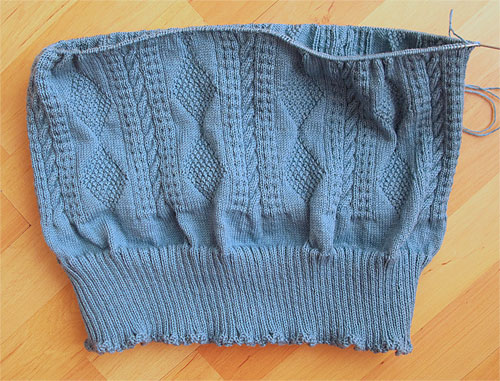
 I’ve been making good progress on the gansey while we’ve been offline, reaching the halfway point on the gussets and dividing front and back. I’ve made these gussets slightly smaller than I usually do, 15 stitches wide instead of my usual 19-21, just to see how it works out. The body will be 7 diamonds long, shoulder to welt, so as you can see I’m not far off finishing the back. Meanwhile I’m still having a lot of fun knitting the pattern, which is almost foolproof (even for me), and which is rapidly becoming one of my favourites—certainly one I’d recommend to a beginner. I’ve been making good progress on the gansey while we’ve been offline, reaching the halfway point on the gussets and dividing front and back. I’ve made these gussets slightly smaller than I usually do, 15 stitches wide instead of my usual 19-21, just to see how it works out. The body will be 7 diamonds long, shoulder to welt, so as you can see I’m not far off finishing the back. Meanwhile I’m still having a lot of fun knitting the pattern, which is almost foolproof (even for me), and which is rapidly becoming one of my favourites—certainly one I’d recommend to a beginner.
 Many thanks for all the suggestions for eye drops to treat my dry eye condition. I still have to talk to a pharmacist, but in the meantime I must admit I rather enjoy spending ten minutes every evening with a warm flannel pressed against my closed eyelids, a sensation not unlike being licked by a very affectionate bison. Many thanks for all the suggestions for eye drops to treat my dry eye condition. I still have to talk to a pharmacist, but in the meantime I must admit I rather enjoy spending ten minutes every evening with a warm flannel pressed against my closed eyelids, a sensation not unlike being licked by a very affectionate bison.
 I spend the downtime listening to an audiobook. In another life I might be meditating, or praying; in this one I’m listening to Proust. In some ways I find it resembles a traditional religious service: I have no idea what the words mean, but they sound nice. I spend the downtime listening to an audiobook. In another life I might be meditating, or praying; in this one I’m listening to Proust. In some ways I find it resembles a traditional religious service: I have no idea what the words mean, but they sound nice.
Finally, here’s Kathleen in her Edinburgh garden wearing the cream Hebridean cardigan I knit recently. Of course, in any other country the beginning of June would hardly be a suitable time of year to wear a gansey—but then, we’ve been through all this before…

[* Gansey Nation is taking a short break and will be back on Monday 3 June*]
How steady are your hands? Steady enough to wipe your eyelids with a cotton bud without poking yourself in the eye? Mine, alas, aren’t, as I’ve been finding out this week to my cost.
You see, I’ve been diagnosed with a chronic dry eye condition (“chronic” just meaning it will never go away). So every night or so I have to soak a cloth in cooled, boiled water and press it against my closed eyes for ten minutes, and then wipe the inside of the softened-up lids with a cotton bud dipped in baby shampoo.
 Cleaning the lower lids is easy; but I find it impossible to negotiate the upper lids without obscuring my line of sight with the bud, which makes aiming it something of a matter of guesswork, like trying to open a high window with a pole while blindfolded. At least once a night I jab myself in the eye, making the cure so far worse than the disease. (On the other hand the sharp pain makes my eyes water, which may be part of the treatment?) Cleaning the lower lids is easy; but I find it impossible to negotiate the upper lids without obscuring my line of sight with the bud, which makes aiming it something of a matter of guesswork, like trying to open a high window with a pole while blindfolded. At least once a night I jab myself in the eye, making the cure so far worse than the disease. (On the other hand the sharp pain makes my eyes water, which may be part of the treatment?)
By the way, did you know that the great Isaac Newton –“great” in the sense of stark, staring mad – once conducted an experiment to see if changes in pressure affected the way the human eye sees colour by inserting a darning needle into the back of his eye and wiggling it about? (This is one of those facts that, once known, can never be forgotten.) There are times when I stand before the bathroom mirror, cotton bud poised, when I fear I am just one sneeze away from replicating his experiment…
 In gansey news, I’ve reached the start of the gussets of my Filey gansey. As usual, I shall be increasing at a rate of one stitch either side of the gusset every 4 rows. It’s always encouraging to reach this stage as it means that dividing front and back isn’t far away, the gansey equivalent of the coming of springtime. In gansey news, I’ve reached the start of the gussets of my Filey gansey. As usual, I shall be increasing at a rate of one stitch either side of the gusset every 4 rows. It’s always encouraging to reach this stage as it means that dividing front and back isn’t far away, the gansey equivalent of the coming of springtime.
Also in gansey news, congratulations to Lynne for completing a rather stunning Eriskay gansey, which you can see pictures of here. (And, if that wasn’t enough, she tells me the temperature was 25C when the photos were taken; it’s a brisk 10C in Wick and the buds on the trees are shrinking again in the sharp north wind like reverse time-lapse photography.)
 There won’t be a blog next week – Margaret will be whooping it up in Edinburgh and I plan to spend the weekend in a paralytic alcoholic stupor – but we’ll be back on Monday 3rd June. There won’t be a blog next week – Margaret will be whooping it up in Edinburgh and I plan to spend the weekend in a paralytic alcoholic stupor – but we’ll be back on Monday 3rd June.
Finally, the cardiganification of the cream cardigan is finally complete. Here’s Margaret to tell us if the operation was a success, and whether the patient will live…
– <> – <> – <> – <> – <> – <> – <> – <> – <> – <> – <> – <> – <> – <> – <> –
 e finito! e finito!
The patient will, I think, survive.
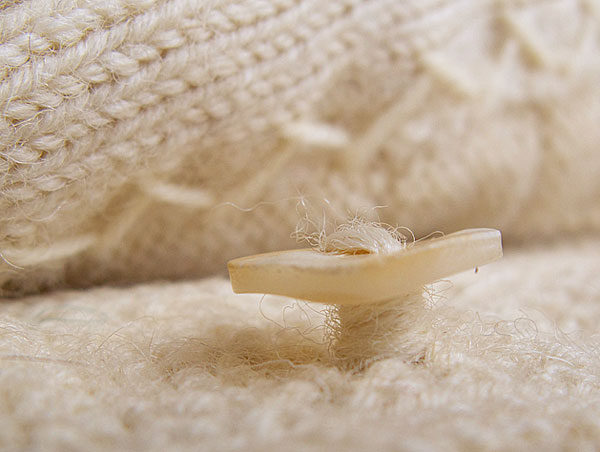
Ends have been darned in, front bands have been severely steamed several times, and the buttons have been sewn on. The buttons are unobtrusive, and not as small as feared; they look about right. As can probably be seen from the photos, they’re two-hole pseudo-shell plastic buttons, with a bit of a ripple (from Ribbonmoon. More buttons than you can shake a stick at. And ribbon.) One side is shiny, the other matt, and I chose the matt to be the upward face. I’ve also sewn them on with a wrapped stand, due to the thickness of the fabric.
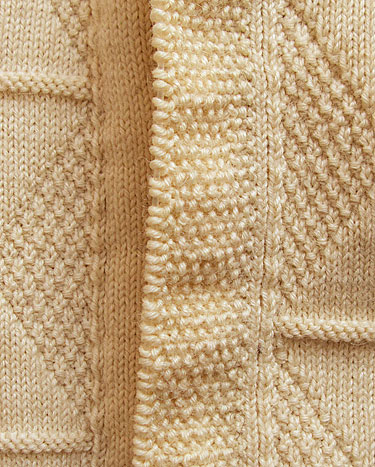
In the last photo, you can also see the herringbone stitching to secure the facings so they don’t flop about. This should also further protect the cut & sewn edges from wear. I’ll be delivering it in Edinburgh later this week.
 It was Margaret’s birthday last Tuesday; as I had the day off work and it was forecast to be bright and sunny (eventually—the day had dawned in thick fog, a real pea-souper, guv’nor) we drove down to the Falls of Shin, a celebrated waterfall and salmon leap about two hours’ south of here, down by the Dornoch Firth. It was Margaret’s birthday last Tuesday; as I had the day off work and it was forecast to be bright and sunny (eventually—the day had dawned in thick fog, a real pea-souper, guv’nor) we drove down to the Falls of Shin, a celebrated waterfall and salmon leap about two hours’ south of here, down by the Dornoch Firth.
 Well, it was spectacular enough in the warm sunshine, but it wasn’t really a waterfall; being more what I believe the experts call a river—which, when you come to think of it, is only a sort of horizontal waterfall, after all. The river comes rushing down a gorge, tumbles over a lip and then crashes a few metres down into a broad pool where it swirls around a bit to get its bearings, and then carries on downstream to the Firth and the open sea. Well, it was spectacular enough in the warm sunshine, but it wasn’t really a waterfall; being more what I believe the experts call a river—which, when you come to think of it, is only a sort of horizontal waterfall, after all. The river comes rushing down a gorge, tumbles over a lip and then crashes a few metres down into a broad pool where it swirls around a bit to get its bearings, and then carries on downstream to the Firth and the open sea.
It was too early in the season for any leaping salmon, so the only leaping being done was by tourists: not from the midges, but from the life-size wax statue of Mohamed Al-Fayed in full Highland dress (kilt and all) which greets you as you enter the visitor centre. It’s quite a shock if you’re not expecting it, and I kept turning suddenly to look at it, to see if it had moved while my back was turned; I didn’t quite trust his smile.
 After a seam-splitting lunch we left for home, following the scenic road around the Firth. It’s very beautiful and lonely out there, the open sweep of water ringed by hills – a real Highland landscape in a way that Caithness (lovely in its own way but undeniably flat as an oil spill) isn’t. After a seam-splitting lunch we left for home, following the scenic road around the Firth. It’s very beautiful and lonely out there, the open sweep of water ringed by hills – a real Highland landscape in a way that Caithness (lovely in its own way but undeniably flat as an oil spill) isn’t.
Then we saw something amazing: the fog had cleared as we went south, but now the hills were once more being enveloped in a wave of mist or low cloud drifting in from the sea, and pouring over them like a tide of dry ice, something from a vintage prog rock concert or a low-budget horror movie. (Ah, mist – nature’s way of letting everyone experience what it’s like to have cataracts.) We tried to outrun it but it caught us within a few miles, so the view for the rest of the journey home was limited to the verges and the taillights of the car in front, as though the universe had run out of power and until someone put another shilling in the meter it was shutting down all non-essential scenery.
Congratulations to Sara Phillips for completing this splendid Norfolk gansey, based on the pattern of John “Sparrow” Hardingham of Sheringham whose picture is in Cromer Museum. The gansey is modelled by her husband Max and a scene-stealing cat; and as so often it just goes to show how effective these kinds of patterns can be.
My own project continues haltingly apace: three diamonds completed now; if I can keep up this rate I’ll be starting the gussets before the end of the month.
Now it’s over to Margaret for an update on the cream cardigan’s buttonholes:
– ~ – ~ – ~ – ~ – ~ – ~ – ~ – ~ – ~ – ~ – ~ – ~ – ~ – ~ – ~ – ~ – ~ – ~ – ~ – ~ – ~ –
1. The buttonhole band is now finished, but still needs a good steaming before it’s ready for the bright lights of Gansey Nation. In the meantime, I’ve done a sample to illustrate how the buttonholes were made.
As you can see, in the first photo, stitches have been picked up along the edge. Then the first segment, from the edge to the first buttonhole, has been knit. The right-hand edge is a 2 stitch tubular selvedge (slip the first two stitches of the row with yarn in back; on the return row purl these stitches). The left-hand edge shows the ‘wrap and turn’, where you make a yarnover before knitting the row. Leave these on the left hand needle.
 3. 2. In the second photo, an i-cord edge has been knit down the left hand side. When the buttonhole is the length required, and you’re back at the left-hand edge of the segment, slip the last two stitches onto the left-hand needle. Knit one, knit the next stitch together with the yarnover next to it. Slip two stitches to the left-hand needle and repeat. When you get down to the bottom of the buttonhole, the last i-cord row will be knit one, knit the next stitch together with one of the picked up stitches. The third photo shows what it look like from the back.
4. 5. In the fourth photo, if you’re still with me here and haven’t dozed off, the next segment has been knit. In this case, the tubular selvedge on the right-hand edge is made using the two stitches from the i-cord edge that you just made. The left-hand edge (not shown) has the yarnovers as per the first segment. The fifth photo shows it from the back.
7. 6. So continue in this way, segment by segment, until all the buttonholes have been knit. The only variation is, on the last segment, to make a tubular selvedge at the both edges. The next step is to close all the buttonholes. Knit back across the row in pattern. Place the last two stitches before a buttonhole on a cable needle and hold them in back. In pattern, work the next stitch on the left-hand needle and the cable needle together. Repeat for the next stitch. This is sort of like a two-needle bind-off, but without binding off. Knit in pattern to the next buttonhole, and repeat. Photos six and seven show the front and back of a buttonhole when this step has been completed.
 After you’ve done all this you should be back at the edge where you started. To cast off, make an i-cord edge similar to that on the left-hand edge of the buttonhole segments: knit three, slip three onto the left-hand needle. Knit two, knit two together; slip three: repeat until all the stitches are gone. Keep an eye on your tension as there’s a tendency, as with many bind-offs, to work too tightly. The last photo shows the i-cord bind-off. After you’ve done all this you should be back at the edge where you started. To cast off, make an i-cord edge similar to that on the left-hand edge of the buttonhole segments: knit three, slip three onto the left-hand needle. Knit two, knit two together; slip three: repeat until all the stitches are gone. Keep an eye on your tension as there’s a tendency, as with many bind-offs, to work too tightly. The last photo shows the i-cord bind-off.
By next week the gansey proper should have its bands steamed and buttons sewn on.
 It’s a Bank Holiday weekend in the UK, and to celebrate we took the old jalopy for a spin up to the north coast, in quest of a tea shop selling good quality coffee and cakes. (This is not as easy as it sounds; in fact, in the first draft of Tolkien’s Lord of the Rings Frodo was offered a choice between venturing to the wastes of Mordor to destroy the Ring of Power, or finding somewhere in Caithness where Gandalf could get a decent latte; our hero chose the former quest because he thought it would be easier…) It’s a Bank Holiday weekend in the UK, and to celebrate we took the old jalopy for a spin up to the north coast, in quest of a tea shop selling good quality coffee and cakes. (This is not as easy as it sounds; in fact, in the first draft of Tolkien’s Lord of the Rings Frodo was offered a choice between venturing to the wastes of Mordor to destroy the Ring of Power, or finding somewhere in Caithness where Gandalf could get a decent latte; our hero chose the former quest because he thought it would be easier…)
Spring hasn’t quite made up its mind yet, and is hedging its bets, like a gambler studying his cards and debating whether to raise or fold. When the clouds part and the sun comes out it’s staggeringly beautiful, there’s really nothing between you and God, and the sky just recedes away to a hazy blue infinity; other times—Saturday, for instance—the temperature is just above freezing, the rain turns to sleet (ah, snow—Caithness’s May blossom) and you start thinking about what you want for Christmas.
 John O’Groat Hotel. The debate still rages as to whether the new extension fits in. The daffodils were out at John o’Groats, as were the first tourists of the season. (You could tell they were tourists by the way they stood on the sea wall and stared longingly into the fog as it condensed on their cycling shorts and tried to imagine a view they could only hear.) The swallows have arrived too, our avian tourists; we saw them clustered around signposts, trying to work out where they’d taken a wrong turning to end up here—birds and humans both thinking, “We came all that way just for this? Well, if you think I’m buying a souvenir lang-may-yer-lum-reek tea towel/ bird bath after this you can blooming well think again…”
 So, it’s not time to put away the gansey just yet, not while there’s still ice in the rigging, and the wind is strong enough to pick up young girls and send them spinning out of Kansas. I’m about a foot up the body of my Filey gansey, the one I plan to donate to the crew of the Reaper (although, as Margaret has observed, my way of describing this as the “Reaper gansey” does rather make it sound as if I’m knitting a sweater for the harvester of souls…). So, it’s not time to put away the gansey just yet, not while there’s still ice in the rigging, and the wind is strong enough to pick up young girls and send them spinning out of Kansas. I’m about a foot up the body of my Filey gansey, the one I plan to donate to the crew of the Reaper (although, as Margaret has observed, my way of describing this as the “Reaper gansey” does rather make it sound as if I’m knitting a sweater for the harvester of souls…).
Now it’s over to Margaret for a progress update on the button bands for the cream cardigan.
– § – § – § – § – § – § – § – § – § – § – § – § – § – § – § – § – § – § – § –
 Despite the general murkiness of the Bank Holiday in Caithness (especially since England is basking in tropical sunshine), progress has been made on the button bands. The button-holding band is now finished. It’s a bit crinkly, but if blocking doesn’t fix it, there is always the option of ripping it out and doing it again. After all, it isn’t a whole gansey. The button-hole band is nearing completion, with only the cast off to do. Both bands will have an i-cord cast off. Despite the general murkiness of the Bank Holiday in Caithness (especially since England is basking in tropical sunshine), progress has been made on the button bands. The button-holding band is now finished. It’s a bit crinkly, but if blocking doesn’t fix it, there is always the option of ripping it out and doing it again. After all, it isn’t a whole gansey. The button-hole band is nearing completion, with only the cast off to do. Both bands will have an i-cord cast off.
 The Oystercatcher on the Roof The buttonholes were made using the method described last week, and generally speaking came out well for something I just made up. Each buttonhole has a tubular/i-cord edge. That is to say, as I knit each section between buttonholes, the right-hand side was knit with a tubular selvedge. At the left-hand side, the yarn was wrapped around the needle at the turn. At the end of the last row of the section, these wraps were used to knit an i-cord edge down to the base of the buttonhole. Then these stitches were used to make the tubular edge on the right-hand side of the next section. None of the sections were bound off, so after the last section was completed, one row was knit in pattern across all the stitches. Except at the buttonholes, where the last two stitches of one segment were overlapped the first two stitches of the next segment. Sort of like a two needle bind-off, but with only two pairs of stitches and not actually binding off. It would of course be easier to visualise if I’d taken pics as I went along, but I’ll do some samples when I’ve finished the band, for better explication and delectation.
 I’d been referred to the eye clinic in Inverness because my optician had spotted a dark patch at the back of my eye – which, as is the way of medical matters, would either prove to be completely harmless (most likely), or potentially very bad (quite unlikely but you never know). I’d been referred to the eye clinic in Inverness because my optician had spotted a dark patch at the back of my eye – which, as is the way of medical matters, would either prove to be completely harmless (most likely), or potentially very bad (quite unlikely but you never know).
 The reverse of the dimple and cable pattern Well, it turned out to be harmless. No tumour, no detaching retina, no problems at all in fact (so as they say in the Hitchhikers Guide to the Galaxy, anything I still can’t cope with is therefore my own problem). Of course, in order to find that out, the doctor had to do the whole anaesthetising and dilating-the-pupils routine which made me look like a surprised barn owl, and shine bright lights into the retina, focusing the beam like a sadistic schoolboy using a magnifying glass to incinerate ants in the back yard. I can still smell a faint trace of smoke even now.
The small broch at Castlehill, with Dunnet Head in the background and slate fences in the foreground I don’t know if you’ve ever had your eye anaesthetised? They do it to check the pressure, and it’s the weirdest feeling. Your eyeball seems to shrink in its socket and feels like it’s been coated in varnish. When you wipe your eye on a tissue you get a bright yellow smear, as though the anaesthetic is made from pureed canaries.
 A Tale of Two Bands At least no one took my picture when I was all numb and dilated like that. I gave a talk to the good people of Castletown Heritage Society last week, and asked them if they could send me some pictures of the occasion so we could use them for publicity purposes; and they kindly obliged. Goodness, it’s a shock to see yourself taken unawares! (Hear that popping noise? That’s the sound my amour propre makes as it bursts like a soap bubble.) In the best of them I look like I’ve just burst out of a cake; or like Gandalf at Aragorn’s coronation party, if the photographer had pressed the shutter just as a slightly inebriated Galadriel, after one too many “Rivendell slammers”, had decided to give the old wizard the wedgie of a lifetime.
 Left-hand band from the front . . . After all these distractions – hospital appointments, talks, and time spent sobbing in my room – I haven’t done a huge amount of knitting. Though I am making inroads into the second diamond, and the pattern is getting clearer by the day. So by way of distracting you from my own project, Margaret is now going to take you through her progress on de-steeking the cream cardigan.
Which, as you can see, is coming along nicely. The stitches for the left-hand band have been picked up, at a rate of two stitches per three rows. The first row is garter stitch, and then there’s about an inch of seed stitch. Aforesaid stitch is good for bands as it lies flat, but it’s about as much fun to knit as ribbing.
 . . . and from the back. The right-hand band will have horizontal buttonholes. I’ll probably knit them individually, as a series of little tabs, then knit a few rows across the top to join them all together. Think of a comb with its teeth at the edge of the centre front – without so many slits of course.
The facing, once the stitches have been picked up, folds very neatly to the back. When all the knitting is said and done, it’ll be catchstitched down so it has no chance whatsoever to flop about.
The band is bubbling a little, but hopefully a good steam with the iron should sort that out. This is the band the buttons will be sewn to. Alas the chosen buttons are a bit too big; to rest nicely on the band I’d have to knit another half inch or so, and that would make the bands too wide. So it’s off to the local knitting shop or t’interwebs to find better buttons.
|
Recent Posts
-
Wick – Double Diamonds: Week 8, 22 June
-
Wick – Double Diamonds: Week 7, 15 June
-
Wick – Double Diamonds: Week 6, 8 June
-
Wick (Double Diamonds): Week 5 – 1 June
-
Wick (Double Diamonds): Week 4 – 25 May
-
Wick (Double Diamonds): Week 3, 18 May
-
Wick (Double Diamonds): Week 1, 4 May
-
Red Hood: Week 5, 27 April
-
Red Hood: Week 4, 20 April
-
Red Hood: Week 3, 13 April
-
Wick (Moss & Diamonds): Week 17, 6 April
-
Wick (Moss & Diamonds): Week 16, 30 March
-
Wick (Moss & Diamonds): Weeks 13-15, 23 March
-
Wick (Moss & Diamonds): Week 12, 2 March
-
Wick (Moss & Diamonds): Week 11, 23 February
-
Wick (Moss & Diamonds): Week 10, 16 February
-
Wick (Moss & Diamonds): Week 9, 9 February
-
Wick (Moss & Diamonds): Week 8, 2 February
-
Wick (Moss & Diamonds): Week 7, 26 January
-
Wick (Moss & Diamonds): Week 6, 19 January
-
Wick (Moss & Diamonds): Week 5, 12 January
-
Wick (Moss & Diamonds): Weeks 3 & 4, 5 January 2026
-
Wick (Moss & Diamonds): Week 2, 22 December
-
Wick (Moss & Diamonds): Week 1, 15 December
-
Wick (J Nicolson): Week 16, 8 December
|
 And then you get a day like Saturday, when the wind drops and the clouds part and the sea is so flat and calm it shimmers like taffy cooling in the tin. It was one of those days when the sky is as blue as a child’s painting, and clouds of delicate white butterflies, disappointed in love and tired of life, try to end it all on your car windscreen as you drive past.
 I’ve been making good progress on the gansey while we’ve been offline, reaching the halfway point on the gussets and dividing front and back. I’ve made these gussets slightly smaller than I usually do, 15 stitches wide instead of my usual 19-21, just to see how it works out. The body will be 7 diamonds long, shoulder to welt, so as you can see I’m not far off finishing the back. Meanwhile I’m still having a lot of fun knitting the pattern, which is almost foolproof (even for me), and which is rapidly becoming one of my favourites—certainly one I’d recommend to a beginner.
 Many thanks for all the suggestions for eye drops to treat my dry eye condition. I still have to talk to a pharmacist, but in the meantime I must admit I rather enjoy spending ten minutes every evening with a warm flannel pressed against my closed eyelids, a sensation not unlike being licked by a very affectionate bison.
 I spend the downtime listening to an audiobook. In another life I might be meditating, or praying; in this one I’m listening to Proust. In some ways I find it resembles a traditional religious service: I have no idea what the words mean, but they sound nice.