Support Gansey Nation -
Buy Gordon a cuppa!
Many, many thanks to those of you who have already contributed!
|
 All things considered, I’ve had more entertaining weeks – and as this one involved a migraine, 2 hours’ worth of psychometric tests, and a 2-day business planning meeting in Exeter, I think a little self-pity is justified. All things considered, I’ve had more entertaining weeks – and as this one involved a migraine, 2 hours’ worth of psychometric tests, and a 2-day business planning meeting in Exeter, I think a little self-pity is justified.
As I’ve mentioned in previous blogs, the body I work for is being wound up at the end of next March, but a handful of people will be retained to carry on the good fight in each region, reporting directly to the head office; I’ve got an interview next week to be one of them, and the tests were a preliminary exercise designed to, I suspect, guarantee the interview panel at least one good laugh on the day.
 In fact, the verbal reasoning and personality tests were fine (except that they always make you choose between alternatives, each of which is too extreme: “Who do you most admire? Adolf Hitler or Jesus Christ?” – that kind of thing). The numerical one was another matter, though – I didn’t finish it, and I suspect I got most of the answers wrong. But, I tell myself, if the chances of a museum needing to calculate how many trees per hectare to replace after the existing ones have been cut down are slim: or if they’re not, I’m in the wrong profession. (Well…) In fact, the verbal reasoning and personality tests were fine (except that they always make you choose between alternatives, each of which is too extreme: “Who do you most admire? Adolf Hitler or Jesus Christ?” – that kind of thing). The numerical one was another matter, though – I didn’t finish it, and I suspect I got most of the answers wrong. But, I tell myself, if the chances of a museum needing to calculate how many trees per hectare to replace after the existing ones have been cut down are slim: or if they’re not, I’m in the wrong profession. (Well…)
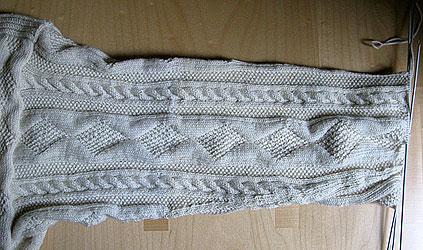
 But, I hear you ask, surely if you’re that bad at “numerical reasoning”, how do you manage to count all those rows with nary a mistake? The answer, shameful as it is, can be seen in this week’s photos: I cheat, and use a crib sheet. After each row I pop the top off my trusty felt-tip pen and score a short black line in two columns – one for the cables, so I know which row to cable on, and the other for the decreases along the seam. It’s a bit of a nuisance, and I always feel that if the Knitting Police get to hear of it they’ll come and beat me up with rubber needles (so the bruises don’t show), or at least raise their eyebrows in a marked manner. But, I hear you ask, surely if you’re that bad at “numerical reasoning”, how do you manage to count all those rows with nary a mistake? The answer, shameful as it is, can be seen in this week’s photos: I cheat, and use a crib sheet. After each row I pop the top off my trusty felt-tip pen and score a short black line in two columns – one for the cables, so I know which row to cable on, and the other for the decreases along the seam. It’s a bit of a nuisance, and I always feel that if the Knitting Police get to hear of it they’ll come and beat me up with rubber needles (so the bruises don’t show), or at least raise their eyebrows in a marked manner.
As for the knitting itself, progress has been slower with all these distractions, but I’m still hanging in there. This week my interview is on Tuesday, and if I get through that there’s another one on Friday with the Chief Executive himself. Who knows what the future holds? But, as Ted Hughes ended a poem about a fox being hunted yet still alive:
“Or will he
Make a mistake, jump the wrong way, jump right
Into the hound’s mouth? As I write this down
He runs still fresh, with all his chances before him.”
[Fox Hunt, from the collection “Moortown”]
That’s me. Still running fresh – for now.

As you’ve probably all heard by now, one of the commonest myths associated with ganseys is that the patterns were so unique to families, or villages, that drowned sailors could be identified by them. But could that really be true? Certainly none of the books I’ve read can quote an instance when it actually happened. That doesn’t make it untrue, of course; but it would be nice to have some evidence.
The myth also begs a number of questions. For instance: how many fishermen were actually lost at sea? How many men drowned and weren’t recovered before their features were disfigured unrecognisably? (Some days you get the fish, and some days the fish get you…) How many had ID in their wallets?

The only way to answer those questions is to do a bit of research. For example, if you matched the burial registers for parishes on the coast against coroner’s inquest papers and local newspapers you’d have a pretty clear idea how many unidentified fishermen were recovered from the sea in that area. Certainly you’d expect the newspapers to report a story like a fisherman being identified by his gansey. Has anyone ever checked this? Did it ever happen?
(Incidentally, when I was an archivist working for the Suffolk Record Office in Lowestoft in the 1980s we had a collection of the old “fishing boat agreements”, boxes of the papers that the crew filled in before each voyage (every week or so) dating back to the 19th century (1852-1946 – I just looked it up online). Like a visitor’s book, each crew member would sign their name, age and role on board. These are fantastic documents; and rumour has it that somewhere in the collections is the signature of the young Joseph Conrad when he was working as a sailor, fresh from Poland – though sadly I think this is just another myth as we never found it.)
But I digress. The other two problems I have with this myth are these: firstly, to identify a man from his gansey, you’d need to know all the patterns of all the villages up and down the coast, which was hardly feasible a hundred years ago. And secondly, let’s face it, the patterns were just not that unique. The same pattern, as worn by the celebrated Henry Freeman, crops up in both Cornwall and Whitby in various guises. We know too that the fishing fleets travelled along the coast; there are pictures of the Scottish fleet in Yarmouth, for example. So everyone would have had a pretty good chance to take a good look at everyone else’s gansey patterns; and of course they’d have copied each other. (In fact, several of Gladys Thompson’s interviewees cheerfully admit as much! After all, we do – why not they?)
The thing we have to remember is that we are looking at them at a fixed point, frozen in time; at the time when they were recorded. So we make a note that this pattern is from this village, but that pattern is from that village – because that’s where we first saw them, crucially at a time when the practice was dying out. But I think the situation was far more fluid than that, much looser. (Which is not to say that some families didn’t keep the same patterns for generations, of course.) I can’t imagine asking every village from Whitby to Cornwall if they’ve lost a fisherman recently – it doesn’t seem very tactful, somehow.
Still, best not to lean too far over the side of the boat, eh? I mean, just to be on the safe side…
 Do you ever have one of those weeks when everything seems to go wrong? When it’s not just a question of your train being delayed (because they couldn’t find a driver – thank you so much First Great Western’s so-called 15.00 Plymouth to Taunton service) or a document disappearing from your file server (everyone agrees that it shouldn’t be possible, but it was) – but also of people wilfully misinterpreting your comments and choosing to take offence … offence which they then spell out in emails running to several sides of A4 paper, in carefully numbered points (1-11, go on, count them), and copied to just about every senior manager in the South West. Do you ever have one of those weeks when everything seems to go wrong? When it’s not just a question of your train being delayed (because they couldn’t find a driver – thank you so much First Great Western’s so-called 15.00 Plymouth to Taunton service) or a document disappearing from your file server (everyone agrees that it shouldn’t be possible, but it was) – but also of people wilfully misinterpreting your comments and choosing to take offence … offence which they then spell out in emails running to several sides of A4 paper, in carefully numbered points (1-11, go on, count them), and copied to just about every senior manager in the South West.
No? Well, then, welcome to my world these last few days. (I seem to recall Abraham Lincoln in one of history’s great quotes, referring to one of his Civil War generals, after yet another stunning defeat, walking round like “a duck that’s been hit on the head with a shovel” – well, that was me this week.)
 Despite all that, I still managed to finish off the cuff (again, casting off following the knit 2/purl 2 ribbing sequence), which looks quite nice when it’s folded back; and, after a few days staring at the pullover like a cat sizing up an indolent emu – and knocking back a beer for Dutch courage – I gritted my teeth and picked up the stitches all round the other sleeve. Despite all that, I still managed to finish off the cuff (again, casting off following the knit 2/purl 2 ribbing sequence), which looks quite nice when it’s folded back; and, after a few days staring at the pullover like a cat sizing up an indolent emu – and knocking back a beer for Dutch courage – I gritted my teeth and picked up the stitches all round the other sleeve.
What a grim task it is! I approach it with all the jollity of a surgeon forced to amputate his own arm. And yet, the funny thing is, it’s never as bad as I think it’s going to be (is that true? Well, possibly): this time it took me just over 45 minutes, which is pretty good going really.
The main challenge, I find, is ensuring an even spacing of stitches up the length of the armhole. I think it’s all because you can’t knit stitches perfectly square: there are more stitches vertically (about 12 to the inch) than horizontally (9-10 to the inch). So if you try to pick up a stitch round the arm for every horizontal stitch that exists (which is a deceptively easy trap to fall into, ahem), you suddenly find you’ve picked up most of your allocation and you’re barely halfway there. Anyone who looks too closely at this latest effort of mine may find lotsofcrampedstitches in one spot, followed by some that are really s-p-a-c-e-d o-u-t…
 Well, I daresay it’s close enough for jazz, as the saying is. Well, I daresay it’s close enough for jazz, as the saying is.
No time to pursue the exciting question of identifying drowned sailors this week – that’ll have to wait till next week. See you then!
 Right, yes, well, the cuff, also known as the sleeve’s draft-excluder. Right, yes, well, the cuff, also known as the sleeve’s draft-excluder.
First of all, the technical stuff. After decreasing down the sleeve by 2 stitches in every 5 rows after the gusset, I ended up with 118 stitches round the wrist. The rule of thumb is to decrease by 1 in 10 into the cuff, which I’ve found usually seems to work OK. My suggestion is that it looks better if you can arrange to decrease on the purl stitches: i.e., knit 2/purl-2-&-decrease. That way you get nice unbroken columns of knit stitches from the sleeve to form the cuff ribs.
The other thing to bear in mind, of course, is that you have to end up with a multiple of 4 (so you end up with an even spread of k2/p2 ribs). So in this case I decreased by 10 stitches to leave me with 108, or 9 ribs of 4 stitches on each of three needles I’m knitting on, which is very neat. Now it’s just been a question of staying sane while knitting a long tubular cuff, probably about 6 inches in all, so it can be rolled back to suit the arm-length of whoever ends up wearing it.
Oh yes, and some books insist that the fake seam stitch should continue down the cuffs independently of the ribbing pattern (the same books say the same thing about the body seams in relation to the ribbing too). Well, nuts to that I say! It may or may not be authentic (whatever that means), but I much prefer the seam to disappear and merge into the purl stitches of the cuff – I just think it looks better that way, and besides, the seam is a fake, after all.
I promised last week to return to the matter of just how waterproof is a gansey. Now, I’m really not convinced. Certainly the ones I knit aren’t exactly waterproof (as exhaustive trials with a bathtub, a bucket and several unwitting volunteers have shown), but that proves nothing, as I dare say mine aren’t knitted in a properly authentic way. But I think they’re tight enough to keep out a light sea spray, or drizzle; and I can’t help thinking that’s what people mean when they say that ganseys are good at repelling water.
As the knitting bishop, Richard Rutt, points out in his book “A History of Hand Knitting” (more of which anon), fishermen usually wear oilskins and waders in high seas and heavy rain; and old photographs show us that trawlermen were no exception. After all, one of the reasons why so many ganseys were left plain until the yoke was because the fishermen wore those great big waders (like clown trousers) that came up to their rib cages and were held in place over the shoulders with braces (which were often knitted, and not made of elastic, so the waders were unlikely to bounce up and down like clown trousers normally do); so it’s not exactly as if they were unprotected from the elements.
Let’s just say the jury’s out on this one. Next week – were drowned fishermen really identified by the patterns on their ganseys?
 Now, here’s an interesting thing. As part of an exhibition on the role of women along the north-east coast, the church of Robin Hood’s Bay has recently hosted a display of ganseys. You can see a newspaper report HERE and a BBC News video HERE, and jolly interesting they are too (especially the video clip, which also shows plenty of happy, apple-cheeked children frolicking in their ganseys back and forth in front of the camera, as happens all the time in the cobbled streets of fishing villages of the North East). Now, here’s an interesting thing. As part of an exhibition on the role of women along the north-east coast, the church of Robin Hood’s Bay has recently hosted a display of ganseys. You can see a newspaper report HERE and a BBC News video HERE, and jolly interesting they are too (especially the video clip, which also shows plenty of happy, apple-cheeked children frolicking in their ganseys back and forth in front of the camera, as happens all the time in the cobbled streets of fishing villages of the North East).
So well done to the organisers and to York St. John University which instigated it all. The idea of a church decked out with traditional ganseys sounds like fun, and it’s good to see traditional knitting in the news without a hint of patronising from the media. (Mind you, I had to smile at the reported comments of a lifeboat man who “admits that modern garments have the upper hand when it comes to practicality and insulation and so the gansey has for many years been in steady decline as a working garment” – though the decline of the fishing industry may have had something to do with it too!)
It’s worth noting, by the way, that two hoary old gansey chestnuts feature prominently in both articles about the exhibition – namely, that ganseys have waterproof qualities, and that a drowned fisherman could be identified by the patterns on his gansey (or at least the village he came from could be). These claims crop up quite often, and I shall be returning to them in next week’s blog and subjecting them to closer scrutiny.
Meanwhile, I continue my slow but stately progress down the sleeve, like an ant making a leisurely stroll down the Statue of Liberty – an elderly ant who’s early for an appointment, with plenty of time on its hands, and who keeps stopping every few paces to catch its breath and take in the view.
|
Recent Posts
-
Wick – Double Diamonds: Week 8, 22 June
-
Wick – Double Diamonds: Week 7, 15 June
-
Wick – Double Diamonds: Week 6, 8 June
-
Wick (Double Diamonds): Week 5 – 1 June
-
Wick (Double Diamonds): Week 4 – 25 May
-
Wick (Double Diamonds): Week 3, 18 May
-
Wick (Double Diamonds): Week 1, 4 May
-
Red Hood: Week 5, 27 April
-
Red Hood: Week 4, 20 April
-
Red Hood: Week 3, 13 April
-
Wick (Moss & Diamonds): Week 17, 6 April
-
Wick (Moss & Diamonds): Week 16, 30 March
-
Wick (Moss & Diamonds): Weeks 13-15, 23 March
-
Wick (Moss & Diamonds): Week 12, 2 March
-
Wick (Moss & Diamonds): Week 11, 23 February
-
Wick (Moss & Diamonds): Week 10, 16 February
-
Wick (Moss & Diamonds): Week 9, 9 February
-
Wick (Moss & Diamonds): Week 8, 2 February
-
Wick (Moss & Diamonds): Week 7, 26 January
-
Wick (Moss & Diamonds): Week 6, 19 January
-
Wick (Moss & Diamonds): Week 5, 12 January
-
Wick (Moss & Diamonds): Weeks 3 & 4, 5 January 2026
-
Wick (Moss & Diamonds): Week 2, 22 December
-
Wick (Moss & Diamonds): Week 1, 15 December
-
Wick (J Nicolson): Week 16, 8 December
|
 All things considered, I’ve had more entertaining weeks – and as this one involved a migraine, 2 hours’ worth of psychometric tests, and a 2-day business planning meeting in Exeter, I think a little self-pity is justified.
 In fact, the verbal reasoning and personality tests were fine (except that they always make you choose between alternatives, each of which is too extreme: “Who do you most admire? Adolf Hitler or Jesus Christ?” – that kind of thing). The numerical one was another matter, though – I didn’t finish it, and I suspect I got most of the answers wrong. But, I tell myself, if the chances of a museum needing to calculate how many trees per hectare to replace after the existing ones have been cut down are slim: or if they’re not, I’m in the wrong profession. (Well…)
 But, I hear you ask, surely if you’re that bad at “numerical reasoning”, how do you manage to count all those rows with nary a mistake? The answer, shameful as it is, can be seen in this week’s photos: I cheat, and use a crib sheet. After each row I pop the top off my trusty felt-tip pen and score a short black line in two columns – one for the cables, so I know which row to cable on, and the other for the decreases along the seam. It’s a bit of a nuisance, and I always feel that if the Knitting Police get to hear of it they’ll come and beat me up with rubber needles (so the bruises don’t show), or at least raise their eyebrows in a marked manner.