Support Gansey Nation -
Buy Gordon a cuppa!
Many, many thanks to those of you who have already contributed!
|
 If Doctor Who had decided to give up skimming through space and time and basically showing off, and instead decided to settle down in the far north of Scotland and convert the Tardis into a cross between a pawnshop and an antiques shop, he might have ended up with something remarkably similar to the wonder that is Wick Heritage Museum. If Doctor Who had decided to give up skimming through space and time and basically showing off, and instead decided to settle down in the far north of Scotland and convert the Tardis into a cross between a pawnshop and an antiques shop, he might have ended up with something remarkably similar to the wonder that is Wick Heritage Museum.
 Wick St Fergus Church Like the Tardis it is deceptively small on the outside. But once you start to explore inside you find there are always more stairs, more galleries, more unexpected levels, and each one crammed with a riot of objects and photographs. You may not travel through space—but you do through time.
I was there as part of a visit from a local school learning about World War Two. We told them about the bombings; and Harry Gray, who has lived through more of Wick’s history than I’ll ever know, told a great story about a tailor who was working upstairs in his shop when the bomb exploded—the floor collapsed and after the dust had settled he found himself standing on the ground floor, thimble and fabric in hand, but with his trousers completely blown off. Highlight of the museum for me is, of course, the gallery devoted to the fishing industry.
Smokey wonders how to get down… They have a colour film from the 1930s showing the trawlers chugging into the harbour for the season, Lerwick and Buckie and Yarmouth boats, the harbourmaster pointing each one where they should berth. Workers heft sacks of coal and carry them onboard over a single long plank that makes tightrope bicycling look like a safe occupation. And there are the fisher lassies, the gutters, gutting and packing herring faster than your eye can follow, an endless blur of knife and hand and silver fish, some of them confident enough to grin shyly at the camera while they work (something I couldn’t have done and still been able to count to ten afterwards).
 In my own gansey I have divided for the front and back, put the half-finished gussets on holders, and am romping up the back, which I will finish in a few days. The armhole will be eight inches from gusset to shoulder strap. This will be another gansey with a traditional collar, so I will not be indenting the neckline and both sides will be identical. In my own gansey I have divided for the front and back, put the half-finished gussets on holders, and am romping up the back, which I will finish in a few days. The armhole will be eight inches from gusset to shoulder strap. This will be another gansey with a traditional collar, so I will not be indenting the neckline and both sides will be identical.
 Somewhere in America. (Probably.) By the way, I should issue a disclaimer: Margaret’s still in America, so cannot be blamed for any of the photos this week (with one exception—see if you can guess which it is).
Incidentally, after the schoolchildren had left the museum I got talking to Harry and told him how much I enjoyed his story about the tailor. There’s a spot of mischief in him: he said that on these occasions he usually asks the children to draw the tailor after the explosion—only for some reason they always depict him with his boxer shorts intact…

I’m afraid it’s a shorter blog this week, as I’ve cut the index finger of my right hand. I don’t mean to say that it’s bleeding so heavily that I’m faint from loss of blood—though the plaster does rather resemble the Japanese flag, and if you want to know what bath time was like just think of David’s famous painting of the Death of Marat— ‘tis but a scratch, as the Black Knight said. But it lies right across the knuckle and typing’s not altogether easy.
24 hours ago, they were on the tree… I was cooking at the time and sliced it on the lid of a tin of kidney beans. It was a few moments before I realised blood was dripping; luckily, chilli’s supposed to be red. (Memo to self: won’t need so much salt this time.)
And it’s officially autumn now: we’re past the solstice, there’s early morning dew on the fields, the cricket season’s ended and the weather’s all over the place. On Wednesday we had driving rain and winds up to 60 mph—on Tuesday evening our plum tree was heavy with hundreds of soft plums, ripe for the picking; 24 hours later the tree was bare and the gravel underneath seemed to have been smeared with plum jam.
South Head, Wick Bay But it turns out we used up the week’s allocation of wind in one day, for by the weekend there wasn’t a breath, not a cloud, just blue sky from horizon to horizon and that dazzling, thin autumnal light that tells you it’s time to start thinking about dusting off the old thermal underwear.
Still, come rain or shine, there’s knitting to be done. Somehow, without my noticing, I’ve reached the gussets and—be still my beating heart—almost finished them. In a couple of days I’ll be dividing for front and back, and then watch out. (The gussets are my usual increase of two stitches every four rows, but starting four rows earlier with a single increase of another purl stitch on the fake seam, to make the first proper increase easier.)
Incidentally, out of curiosity I looked up words that rhyme with gusset, and it seems there’s only one: russet. You can do it with two or more words, like fuss it, but that’s cheating. So, if anyone feels like writing a sonnet in praise of gussets anytime, maybe think about haiku instead
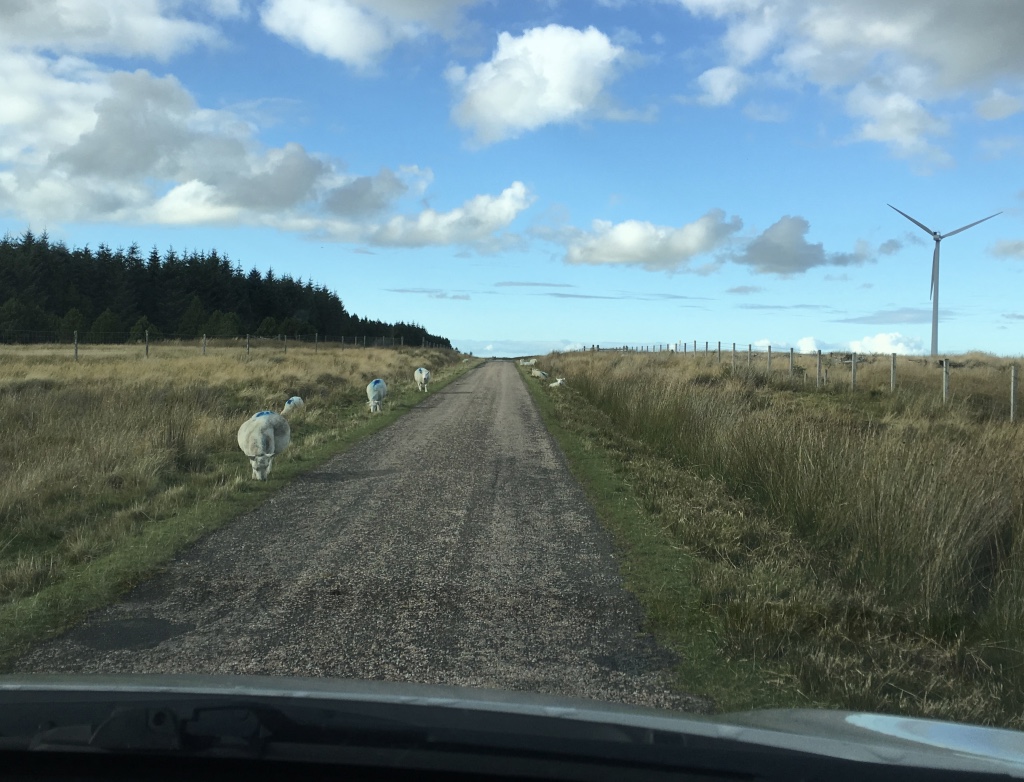
 Honour guard of sheep, Camster And now I face my latest challenge: how to knit with a plastered finger sticking out at right angles like the gun barrel of a tank; given that when I tried earlier I was about as adroit as someone learning to untie knotted rope with a marlinspike.
The other challenge, namely how I do the washing up without all the dishes coming out pink, can wait till later…
 I found a spider in the bathroom the other day. It wasn’t actually threatening me—no suggestion that it was about to drop onto my scalp, paralyse me with a quick jab of venom and lay its eggs in my brain—it just perched in a high corner of the shower, waggling its eyestalks at me suggestively in a hi-there-big-boy sort of way. So naturally one of us had to go. I found a spider in the bathroom the other day. It wasn’t actually threatening me—no suggestion that it was about to drop onto my scalp, paralyse me with a quick jab of venom and lay its eggs in my brain—it just perched in a high corner of the shower, waggling its eyestalks at me suggestively in a hi-there-big-boy sort of way. So naturally one of us had to go.
I have something of a phobia towards spiders. It’s not exactly irrational—when I was a child I awoke one night to find one scuttling across my face. Nightmares involving spiders sealing my eyes and mouth with webs swiftly followed. Of course, I know that British house spiders are harmless, they’re more afraid of us and their natural prey is about the size of a pollen grain—I understand all that. But then again, their looks are against them: they do rather resemble something assembled by Satan on one of his days off from bits of twine and matchsticks and leftover evil he found lying around on his workbench.
 The Stash – plenty of ganseys still to knit… And it’s not just a question of looks. Take lions, now: they kill creatures for food—cute creatures, too, the kind that appear on greetings cards. And yet there’s a sporting chance when a lion goes after a gazelle that the gazelle might get away; it’s a sort of 200-metre hurdles with the chance of a decent meal instead of a gold medal at the end. (And if you look closely at nature documentaries you can see the lions give a little nod when the prey eludes them, a gesture of respect between equals.)
The Geo of Sclaites at Duncansby Head in the fog Not so, spiders: they basically mug their victims in dark alleys, knifing them in the back, then taking their wallets and going off sniggering. If they had any sporting instinct, instead of sneakily weaving webs to trap the unwary, they’d build hang gliders and go after moths and flies in the air. And you never see a spider with its back turned, counting to a hundred under its breath, while its prey runs away and hides, do you? There you are, then: I rest my case.
Meanwhile, one knits. Rather a lot, in fact, so that I might even reach the gussets in the next week. What a great pattern this is: a real classic. (I tell myself it will be big enough when it’s blocked, but the pattern does rather concertina in on itself so that I seem to be knitting the gansey equivalent of a surgical stocking, or a tourniquet.)
As for the spider, of course I didn’t kill it. Most house spiders you see at this time of year are perfectly blameless males looking for a mate; and anyway, every spider you see means up to 2,000 fewer bugs in your house each year. No, I trapped him in a jam jar and released him back to the wild, along with some loose change and a caution not to spend it all on drink. looking for a mate; and anyway, every spider you see means up to 2,000 fewer bugs in your house each year. No, I trapped him in a jam jar and released him back to the wild, along with some loose change and a caution not to spend it all on drink.
[By the way, Margaret has eluded the guards again and escaped to America for a month. As a result I’m afraid the quality of photos on the website will take a dive, rather, and I won’t be able to add any images to the Readers’ Gallery. Normal service will be resumed just in time for Halloween…]
 It’s not easy being green There are, as I think the Prophet Hezekiah first pointed out, three steps to heaven: unfortunately it turns out there are several thousand, or so it seems, to get onto the cliffs overlooking the celebrated Stacks of Duncansby.
I’ve mentioned before that Duncansby Head, a narrow promontory jutting out into the North Sea a mile or so from John O’Groats, is the real north-easterly tip of mainland Scotland. One side looks north towards Orkney and the Skerries (a series of small, uninhabited islands); the other looks out eastward over the open ocean, and it’s here the stacks, a couple of spiked rock formations protruding sharply from the water, are situated.
 Befogged You have to tramp almost a kilometre over the headland to see them, and then about the same up another steepish track to the top of the cliffs to look down on them. There’s a rocky arch (called Thirle Door), and the stacks proper, which look like the heads of two pointy-headed giants out for a swim. It’s stunningly beautiful.
We made a couple of trips up to Duncansby this week. The first time we were beset by fog, which was at times so thick as to reduce visibility to a few metres. The few tourists we encountered came blundering out of the murk like the zombie apocalypse; I lost my sense of direction completely and started walking round in circles like a one man Blair Witch re-enactment society until Margaret set me right.

I’d taken last week off from work and spent so much time on the couch the police wouldn’t have needed a chalk outline in the event of my murder; my body form was indented into the sofa cushions like a pre-cast mould. I’d intended to do lots of things, go to many places, but instead ended up just reading, listening to music, going for walks and knitting. And, you know, I had a great time.
 Unfogged Ah, yes: knitting. As you can see, the green Scarborough gansey is washed and blocked and good to go. I couldn’t be happier with it: I love the colour (Frangipani bottle green) and the fit, and find the pattern strangely hypnotic. The only downside so far is people behind me in the queue at the Post Office file their fingernails on it between my shoulder blades.
And I’ve started my next project. Well, I say started—I’m actually a third of the way up the body. (Bruckner symphonies last a long time, what can I say?) As promised it’s an old favourite, the Matt Cammish gansey from Filey in Frangipani pewter yarn. I’ll say more about this next week, and give the pattern chart.
Incidentally, the arch I mentioned, Thirle Door, has a curious name: a thirle means a hole in a wall. So it’s one of those tautologies, like River Avon (“river river”) and Bree Hill (“hill hill”)—this one is “door door”. As for Duncansby, or “Duncan’s Farm”, we have an old map in the record office which gives the name as “Dungsby”—this may just be a record of how it was pronounced; on the other hand, as we can testify, there’s plenty of evidence underfoot, if any were needed, that sheep are not housetrained…
 Less than ten miles south of Wick lies the extraordinary archaeological landscape of Yarrows, a flattish, undulating, mostly empty moorland covering several square miles of geography and some seven thousand years of history. (Yes, it’s time for another instalment in our occasional series, “A Bunch of Stones Lying in a Field”.) Less than ten miles south of Wick lies the extraordinary archaeological landscape of Yarrows, a flattish, undulating, mostly empty moorland covering several square miles of geography and some seven thousand years of history. (Yes, it’s time for another instalment in our occasional series, “A Bunch of Stones Lying in a Field”.)
The broch & Loch Yarrows People have been living here since the Stone Age, c.5,000 BC, and there are cairns and hut circles and even a standing stone, a narrow blade that sticks up like the gnomon on a sundial. On Saturday we just went down to Loch Yarrows to look at the wonderfully atmospheric Iron Age broch overlooking the loch.
This was our second visit. The first time we were defeated by the world’s most spectacularly useless information board: a study in abstract art, it depicts the trail without reference to actual landmarks, or even what you might expect to see. (It’s probably a hangover from the war, when it was originally put up to obfuscate invading Nazi archaeologists.)
 Huh? The way to the broch lies across several fields occupied by a stud farm, where ponies cluster as thick as midges; they have a strategy based on Jurassic Park’s velociraptors where one distracts you to the front, and while you stroke its forehead another two go through your pockets looking for apples, or failing that your wallet.
Abandoned buildings, Loch Brickigoe It’s a stunning location, desolate and wild, and so flat you can see across Loch Yarrows, over Loch Hempriggs, and all the way to the sea beyond. The broch is ruined now, little more than foundations and an overgrown mound of stone. You have to watch your step, too—I mistook a grass-covered watery ditch for solid ground and next thing I knew I was about three feet shorter, with a cold, wet sensation spreading upwards from the region of my socks.
Riverside path at sunset, Wick And the Scarborough gansey is finished, my fifth completed this year, with just the washing and blocking to go. I’m particularly pleased with the sleeves (18.5 inches plus 3-inch cuffs of 84 stitches), which seem to be a good fit around the forearms and wrists. It’s interesting that there are so few gansey patterns like this where the yoke isn’t divided horizontally or vertically into panels or bands. I wonder why that is? It’s certainly very effective.
As for the broch, it’s strange to think that people were living there when Jesus was alive. They don’t seem to have been knitting, though: I always tend to think of knitting as something that must have started about the time the first humans wondered what to do with all the leftover bits from mutton, but apparently not. Knitting as we know it dates from several centuries later, which raises the question: what did on earth they do in the long Caithness winter evenings?
|
Recent Posts
-
Wick – Double Diamonds: Week 8, 22 June
-
Wick – Double Diamonds: Week 7, 15 June
-
Wick – Double Diamonds: Week 6, 8 June
-
Wick (Double Diamonds): Week 5 – 1 June
-
Wick (Double Diamonds): Week 4 – 25 May
-
Wick (Double Diamonds): Week 3, 18 May
-
Wick (Double Diamonds): Week 1, 4 May
-
Red Hood: Week 5, 27 April
-
Red Hood: Week 4, 20 April
-
Red Hood: Week 3, 13 April
-
Wick (Moss & Diamonds): Week 17, 6 April
-
Wick (Moss & Diamonds): Week 16, 30 March
-
Wick (Moss & Diamonds): Weeks 13-15, 23 March
-
Wick (Moss & Diamonds): Week 12, 2 March
-
Wick (Moss & Diamonds): Week 11, 23 February
-
Wick (Moss & Diamonds): Week 10, 16 February
-
Wick (Moss & Diamonds): Week 9, 9 February
-
Wick (Moss & Diamonds): Week 8, 2 February
-
Wick (Moss & Diamonds): Week 7, 26 January
-
Wick (Moss & Diamonds): Week 6, 19 January
-
Wick (Moss & Diamonds): Week 5, 12 January
-
Wick (Moss & Diamonds): Weeks 3 & 4, 5 January 2026
-
Wick (Moss & Diamonds): Week 2, 22 December
-
Wick (Moss & Diamonds): Week 1, 15 December
-
Wick (J Nicolson): Week 16, 8 December
|
 If Doctor Who had decided to give up skimming through space and time and basically showing off, and instead decided to settle down in the far north of Scotland and convert the Tardis into a cross between a pawnshop and an antiques shop, he might have ended up with something remarkably similar to the wonder that is Wick Heritage Museum.

 In my own gansey I have divided for the front and back, put the half-finished gussets on holders, and am romping up the back, which I will finish in a few days. The armhole will be eight inches from gusset to shoulder strap. This will be another gansey with a traditional collar, so I will not be indenting the neckline and both sides will be identical.