Support Gansey Nation -
Buy Gordon a cuppa!
Many, many thanks to those of you who have already contributed!
|
 National Seashore, P'town  Nobska Light So here we are, back in the UK after 10 days in sunny – and unseasonably hot – Massachusetts. I’m told that Britain experienced a (brief) heat wave too while we were away, but there was little sign of it when we got back: so after sweltering in the high 80s we’ve plunged back to the mid to low 50s; from finding it too hot to wear long trousers, suddenly we’re back to scarves and sweaters. And ground frosts! In June! I ask you: is this fair?
But somehow the vista of unrelieved grey seems appropriate. After all, we have a new austerity government here in the UK, a rather strange coalition of the liberal and conservative parties, which as I understand it means that the conservatives have promised to be less beastly than they’d like. Actually, the coalition isn’t as strange as it looks: after all, the key players all seem to have been at public school together, or had the same nannies, or something – and besides, 18 out of 23 of the new cabinet are millionaires. So naturally their response to the huge debt caused by the financial sector is to blame the public sector and cut public spending. It’s like coming home to find the country’s been invaded by aliens while we were away, and we’re now all slaves of Zarg the Destroyer, or something.
 Ah, well. This could just be the jet lag talking, of course. At least we got away – how lucky was that? Edinburgh airport was closed for the ash cloud until 1pm, but as our flight was at 1.45pm, it was one of the first to take off. And the British Airways strike didn’t start till the next day – so the gods were on our side. Hurrah! Ah, well. This could just be the jet lag talking, of course. At least we got away – how lucky was that? Edinburgh airport was closed for the ash cloud until 1pm, but as our flight was at 1.45pm, it was one of the first to take off. And the British Airways strike didn’t start till the next day – so the gods were on our side. Hurrah!
 P'town Harbor So we had a great time in Cape Cod – many thanks to Gail and Bill for their hospitality, and for all the driving (and Nat for the audiobooks). The highlight of the trip would probably be the visit to Provincetown in the blistering sunshine, where the Village People look is never out of fashion – run a close second by the opportunity to buy a Red Sox baseball cap. Well, that and the ice cream. Oh yes, and the cider. And the beaches. Plus the coffee. In fact, there were many highlights, many of them subtly hedonistic (i.e., I kept my shirt on, but spilt things on it).
 In my previous post I mentioned some big news about my career plans. Well, big tease that I am, I’m going to save that till next time, as this blog has been delayed too long already, and feels like it’s past my bedtime, even though it’s just after noon (so no change there). In my previous post I mentioned some big news about my career plans. Well, big tease that I am, I’m going to save that till next time, as this blog has been delayed too long already, and feels like it’s past my bedtime, even though it’s just after noon (so no change there).
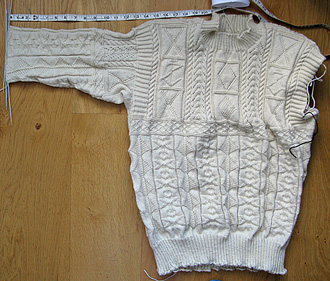
I didn’t take the knitting with me to the States – it would have been too hot to have it on my lap, anyway. But in between bouts of falling asleep and awakening with the sensation of having eaten library paste in my sleep, since i got back I’ve finished the pattern on the sleeve. All that remains is the inch or so of plain knitting and the cuff, before trying to remember what the hell I did so I can repeat it on the other sleeve. The sooner I get it finished, the better – if summer doesn’t arrive soon, I may need it…
 Ladyslipper |
 Lathyrus japonicus |
 It’s not often I compare myself with Shroedinger’s Cat, but this is definitely one of those times. It’s not often I compare myself with Shroedinger’s Cat, but this is definitely one of those times.
You see, Margaret and I are due to fly to the USA this afternoon for a holiday – first we catch a flight from Edinburgh to London, then from London to Boston. But – and how unfair is this? – the volcanic ash cloud from Iceland is currently drifting back over the UK, and is affecting (you guessed it) airports in Scotland and London. Edinburgh airport is currently closed till 1pm, and our flight is scheduled for 1.45pm. Tension mounts.
And this is where the cat comes in. If you remember, Schroedinger’s Cat is a thought experiment, devised to show how bizarre quantum theory really is. The cat is in a box, with a container of poison, and a small quantity of radioactive particles which have an equal chance of decaying or not. If they do decay, then a mechanism releases the poison and the cat is killed; if they don’t, the cat survives. The weird thing is, according to quantum theory, the cat is both equally alive and dead until the box is opened and it is observed – when it is found to have been either dead the whole time, or alive. But both states exist until it is observed. Or something like that.
 Sleeve detail  Body detail So with me and this blog. By the time you read this, I will either be off to wild fun and excitement in the States, or sitting at home thinking some very black thoughts indeed (though I may not interact with any poison – you can take a metaphor too far sometimes). Both futures are, at present, equally possible. Of course, the challenge you will have is observing me – especially if I don’t leave the flat – but that’s another matter.
Meanwhile, I paid a return visit to the Ear, Nose and Throat department last week where they stuck that wire coat hanger up my nose again. The fun part was, this time I got to watch it on TV. I don’t know if you’ve ever seen the inside of your nose in close up? Mine was very pink, rather unpleasantly hairy in parts, and disconcertingly squishy in others – like poking a strawberry blancmange with a biro. On the whole, I have come to the conclusion that humans look at their best when seen from the outside. The upshot is, I am now on the waiting list for a septoplasty – I’m afraid you’ll have to look it up, as after having the after-effects explained to me (in which the words “crusting” and “discharge” featured once more, but this time with illustrations) – I don’t really want to think about it right now.
 It’s been hard to concentrate on knitting with all this going on, but as you will see I’m progressing slowly down the sleeve. It takes about 5-6 minutes to do a row at this stage, and as I’m decreasing on every 5th row, I tend to work in blocks of 5 rows at a time, or about 30-35 minutes at a stretch (which is conveniently the same length as a Mozart piano concerto!). It’s been hard to concentrate on knitting with all this going on, but as you will see I’m progressing slowly down the sleeve. It takes about 5-6 minutes to do a row at this stage, and as I’m decreasing on every 5th row, I tend to work in blocks of 5 rows at a time, or about 30-35 minutes at a stretch (which is conveniently the same length as a Mozart piano concerto!).
When I come back from America – if I get there – expect some exciting, possibly foolhardy news about my career plans. Now I’m off to observe some cats, and hope that at least 50% of them survive the experience.
Next scheduled post to this blog will be on Tuesday 1 June 2010, deus vult.
 Apologies for the brief disappearance of the blog recently – the web host foreclosed the mortgage, basically, but we sent them round a basket of vegetables from the allotment and offered to wash their car, and in the end they relented and we’re back on line. Apologies for the brief disappearance of the blog recently – the web host foreclosed the mortgage, basically, but we sent them round a basket of vegetables from the allotment and offered to wash their car, and in the end they relented and we’re back on line.
Aren’t penguins fun? Last week was Margaret’s birthday, so we made an excursion up to Edinburgh zoo, to see all the arctic animals feeling right at home, basking in a typical Scottish spring. Lord, it was cold!
The special attractions weren’t very special (ordinary attractions?) – it was out of season, so the famous penguin walk was more of a 3-metre waddle; the big cat habitats were being rebuilt so they were absent; and the aviary where you can buy a pot of nectar and have birds flutter down and sip it from your hand had just had a new air conditioner, which meant that the birds were hiding somewhere in the rafters sneering down at the visitors and making rude suggestions.
But it did have lots of penguins, and a day in which penguins feature is never wasted. I particularly like the way they just stand still with their flippers dangling, their heads on one side and their lower beaks hanging open like a rather vapid, slack-jawed member of the upper classes waiting for the rain to stop. They’re sort of like aquatic cats, funny and unpredictable, and you never know what they’re thinking (though I suspect it’s along the lines of: “Fish! Oh, a stone! Fish! Hey, a shiny thing! OK, I’m going offline now”). Watching them on their celebrated walk was like watching a three-legged-sack race at a village fair.
  Other highlights included the sleeping koalas, with their scrunched-up, origami faces, and of course the otters, who are practiced media whores, rolling over on their backs and obligingly rubbing their tummies for the cameras, before signing autographs and talking to their agents on cell phones. Other highlights included the sleeping koalas, with their scrunched-up, origami faces, and of course the otters, who are practiced media whores, rolling over on their backs and obligingly rubbing their tummies for the cameras, before signing autographs and talking to their agents on cell phones.
Otherwise I knit and bake bread. I tried a new recipe for pain de campagne over the weekend, a French wholemeal-rye bread that requires a starter at least a day in advance of baking the loaf. I made the mistake of just following the recipe, and added all the water in one go – big mistake! Instead of the thick, moist dough I was promised I achieved a sort of primordial soup. When I poured it out to knead it flowed across the counter like lava from an Icelandic volcano.
 After adding handfuls of flour to stiffen its resolve, as a builder mixes cement, I finally managed to persuade it to stay in one place, like an over-eager puppy being trained to sit. By this time I was so coated in flaking dough that I resembled one of those Nazis in an Indiana Jones movie who shouldn’t have looked. Then, when I left it to rise it inflated like a football attached to an air hose. The recipe called for it to rise for 4 hours, but after 45 minutes it had doubled in size and had developed its own gravitational field. In retrospect I shouldn’t have baked with it – I realise now that I’d inadvertently discovered Cavorite, the substance from HG Wells’ The First Men In The Moon that defied gravity and made spaceflight possible. After adding handfuls of flour to stiffen its resolve, as a builder mixes cement, I finally managed to persuade it to stay in one place, like an over-eager puppy being trained to sit. By this time I was so coated in flaking dough that I resembled one of those Nazis in an Indiana Jones movie who shouldn’t have looked. Then, when I left it to rise it inflated like a football attached to an air hose. The recipe called for it to rise for 4 hours, but after 45 minutes it had doubled in size and had developed its own gravitational field. In retrospect I shouldn’t have baked with it – I realise now that I’d inadvertently discovered Cavorite, the substance from HG Wells’ The First Men In The Moon that defied gravity and made spaceflight possible.
Meanwhile on the gansey I promenade down the sleeve, doing a bit now and then as the mood takes me, and slowly working my way through Wagner’s oeuvre – and, as the man said, people in a hurry shouldn’t be listening to Wagner anyway.
(Sigh.) News just in. First it was the threat of volcanic ash from Iceland. Now British Airways cabin crews have announced that they’re going on strike just when we’re planning on visiting Margaret’s family in the States next week. They’ve got a week to reach an agreement or there’s going to be trouble, I can tell you…
 Well, I duly had my interview for the job working for the Western Isles Council last week – and I didn’t get it. Well, I duly had my interview for the job working for the Western Isles Council last week – and I didn’t get it.
It’s a disappointment, though unlike the Hebrides themselves, I can honestly say it’s not the end of the world – since there were enough complications to make me a bit ambivalent. It would, for example, have meant relocating yet again for a temporary job, it’s a very long away from my parents who are in their eighties, and then there’s the wind, rain and the endless winters to consider. I imagine it would be like living in an Ingmar Bergman movie. Plus I very much doubt there’s a Starbucks on the islands.
And, as ever in these situations, I tend to feel that somewhere out there is something more exciting than the job I didn’t get. So – I’ve just turned 50, I’m unemployed, and we’re in the biggest recession and public spending squeeze for 70 years – the world, as Terry Pratchett would say, is my mollusc. How bad can it be?
 In the meantime, I’m free to indulge my three great passions (or the ones I’m prepared to discuss in public anyway – and I’ve always maintained, like PG Wodehouse’s Uncle Fred, that a more enlightened judge would have let me off with just a caution): namely, baking bread, listening to Wagner – and, of course, knitting ganseys. In the meantime, I’m free to indulge my three great passions (or the ones I’m prepared to discuss in public anyway – and I’ve always maintained, like PG Wodehouse’s Uncle Fred, that a more enlightened judge would have let me off with just a caution): namely, baking bread, listening to Wagner – and, of course, knitting ganseys.
After last week’s herculean effort picking up the stitches for the sleeve, all I had to do next was get the pattern to fit. I wanted to use the same pattern elements as the body, so the gansey would look all of a piece. I’ve replicated the yoke pattern at the top of the sleeve (diamonds flanked with inverted yarn-over chevrons), with below that a narrow band of the diagonal trellis pattern as a border, while the rest of the sleeve will comprise the tree and starfish patterns all the way down to the cuff. Each pattern element is exactly the same as it was on the main body of the gansey (I know some patterns traditionally were knitted smaller on the sleeves, but I’ve decided to keep this one big and chunky). I’ve only made the sleeve “yoke” one panel row deep (the body yoke was 3 panels deep), because I reckon the main patterned part of the sleeve should end above the elbow – or at least I think it looks better that way.
 The gusset decrease was 2 stitches every fourth row, to match the previous rate of increase. Now that I’ve finished the gusset, I’ve switched to a rate of decrease of 2 stitches every 5 rows, so as not to run out of sleeve too soon. The gusset decrease was 2 stitches every fourth row, to match the previous rate of increase. Now that I’ve finished the gusset, I’ve switched to a rate of decrease of 2 stitches every 5 rows, so as not to run out of sleeve too soon.
So at the moment I’m doing quite a bit of knitting – as you can tell by how much of the sleeve’s been done – while listening to Wagner and waiting for the dough to rise. Now I’ve got used to baking with fresh yeast I’m getting ready for the next great trial: preparing a sourdough starter with wild yeast and keeping that alive indefinitely to bake with. (I already keep back some of each batch of dough to use in the next loaf, but it’s not the same.) And then my final challenge – a harvest loaf (Google it if you don’t know what they look like) – and then a gansey made out of bread…
Greetings all!
I thought I’d have a go at my gansey tutorial Part 2 this week, since I’ve finished the neck – 1.5 inches of ribbing – and reached my least favourite part of the process, viz., picking up the stitches along the armholes for the sleeves.
I appreciate that this will be very old news to some of you, who I imagine can do this blindfold, and probably do at knitting workshops, like the Marines disassembling and reassembling their rifles. But, as I say, I’m hoping to build this up into a separate section for the website so that someone who has never done any of this before will hopefully get some tips on how to go about it. So, feedback welcome (and, of course, if you have any tips of your own, please feel free to share)!
First of all, I measured the actual size of the armholes, and they came to 8.5 inches from the end of the gusset to the top of the shoulder. Now, I know my stitch gauge is about 9.25 stitches to the inch, so a simple calculation (8.5 x 9.25) tells me that I have just over 78 stitches to pick up for each side. Add one for a central stitch and an odd number, and that gives me 157 stitches all told. So now I know what i have to do; I just have to do it.
When back in the mists of time I stopped knitting in the round and divided for the armholes, I left the gusset stitches on a holder (1). I find that old gansey 5-ply yarn makes a pretty good stitch holder, so I just knit a piece of old yarn through the gusset stitches and forget about them for a few months. (One advantage of using old yarn is that it’s very flexible, and hasn’t got any pointy bits to jab me in unfortunate places when I sneeze.)
I always start the armholes by picking up a few stitches of the gusset first. This has a couple of real advantages. You see, if I start picking up the armhole stitches straight away, I tend to end up with a larger, looser first stitch (I assume this is a failing in my technique, but every time I start to pick up stitches without a run-in like this I can’t keep the tension as taut as I’d like and the result after a couple of rows is a very noticeable hole. This way I can start knitting with a new ball of yarn for several stitches of plain knitting, and for some reason the tension is much easier to maintain.) The other advantage is that I’m starting the gusset in the middle – which means that every time I decrease from hereon in, the decrease is happening on the same row on both sides of the gusset; otherwise the left side decrease would be out of sync with the right side by a row.
Anyway, you now have to get the stitches off the holding yarn and onto a double-pointed needle. Thread a needle (hereinafter “Needle 1”) through half a dozen or so stitches on the left side of the gusset (2), slide the yarn out from those stitches (3) and re-tie the yarn to prevent any stitches dropping off when you’re not looking (4).
Drop a good length of the end of the new ball of yarn you’re going to knit with into the armhole (5). (I tend to go for long ends of 4-6 inches to keep them out of the way, but that’s a bit excessive, I know – so long as you’ve got enough to darn them in at the end, that’s all you really need.) When you’re happy with the length of your yarn end, hold it in position by anchoring it between thumb and finger (6) to ensure a good tension on your first stitch – otherwise it will be too loose and you’ll end up with the dreaded hole, as mentioned above. Insert another double-pointed needle (hereinafter “Needle 2”) through the first stitch (7), and knit a plain stitch in the usual way (8-10).
Knit the rest of the stitches on Needle 1, until you have 2 gusset stitches left plus the purl seam stitch (11). Make a decrease by knitting the last 2 gusset stitches together (12-15). This helps to make a sharp diamond shape for the gusset, and also helps with your counting as you progress down the sleeve: because the first row is going to be your pick-up row, it won’t be part of the pattern – the pattern will start on the next row, which will be the first “real” row; so, by making a decrease on this row, you can keep the gusset and the pattern in sync as you progress down the sleeve. (Obviously you also have to remember to decrease when you reach the other side of the gusset too.)
And after all that, you’re ready to start actually picking up stitches – but at least you don’t have to worry about flabby yarn tension at the same time!
Insert Needle 1 through the first of the edge stitches, making sure you get all of it (16). It should look like an ear of wheat on the needle. (Usually the edge stitches are curled inwards a bit and are almost at right angles anyway, so they’re not that hard to see.) To pick up the stitch, just knit a plain stitch in the usual way (17-20) by inserting Needle 2 through the opening you’ve created, looping the yarn over it, pulling it back through and slipping the stitch from Needle 1 to Needle 2.
Repeat up the armhole for as many stitches as your stitch gauge demands (21). This is why it’s important to add an extra stitch on the edge of your armhole, because the row on the very end of each side is sacrificed as you pick up your new stitches – so always make your yoke 2 stitches wider than your pattern demands. You will notice the row next to them becomes very clearly delineated as you progress up the armhole (22 and 23), which is another way of telling you that you’re doing it right.
 |
|
One point to remember is that your (horizontal) stitch gauge will be a smaller number than your (vertical) row gauge. In my case, I knit about 9.25 stitches to the inch, but get about 12 rows to the inch. So you have to be careful not to fall into the trap of picking up every edge stitch, or you’ll have about a quarter more stitches than you need, all too close together. I try to use landmarks on the yoke pattern to help me get the spacing about right – in this case, the ladder on each side of the yoke pattern makes a helpful marker. There are 16 steps on each ladder, so if I pick up some 9 stitches for every 2 steps I should be about right (78 divided by 16 equals 4.5).
The only other thing to look out for is that it’s very easy to pick up just half a stitch – easier than picking up a whole stitch, in fact. In this case, instead of the “ear of wheat” effect referred to above, you just get a single loop on your needle (24), and if the stitch is completed it stands out from the rest of the row (25). This is a Bad Thing and is to be avoided unless you wish your name to be a hissing and a byword in knitting circles.
Well, there we are. No sewing involved at any stage.
Sorry if that was (a) too obvious for words, or (b) too tiresome and complicated (delete as applicable). This next week is a momentous one as I reach my fiftieth year on this earth, and have a rescheduled interview with the Western Isles Council (they’re coming to Edinburgh this time!). So it could be a remarkably good week, or…
|
Recent Posts
-
Wick – Moss Variation: Week 9, 14 September
-
Wick – Moss Variation: Week 7, 7 September
-
Wick – Moss Variation: Week 6, 31 August
-
Wick – Moss Variation: Week 5, 24 August
-
Wick – Moss Variation: Weeks 1-4, 17 August
-
Wick – Double Diamonds: Week 12, 20 July
-
Wick – Double Diamonds: Week 11, 13 July
-
Wick – Double Diamonds: Week 10, 6 July
-
Wick – Double Diamonds: Week 9, 29 June
-
Wick – Double Diamonds: Week 8, 22 June
-
Wick – Double Diamonds: Week 7, 15 June
-
Wick – Double Diamonds: Week 6, 8 June
-
Wick (Double Diamonds): Week 5 – 1 June
-
Wick (Double Diamonds): Week 4 – 25 May
-
Wick (Double Diamonds): Week 3, 18 May
-
Wick (Double Diamonds): Week 1, 4 May
-
Red Hood: Week 5, 27 April
-
Red Hood: Week 4, 20 April
-
Red Hood: Week 3, 13 April
-
Wick (Moss & Diamonds): Week 17, 6 April
-
Wick (Moss & Diamonds): Week 16, 30 March
-
Wick (Moss & Diamonds): Weeks 13-15, 23 March
-
Wick (Moss & Diamonds): Week 12, 2 March
-
Wick (Moss & Diamonds): Week 11, 23 February
-
Wick (Moss & Diamonds): Week 10, 16 February
|


 Ah, well. This could just be the jet lag talking, of course. At least we got away – how lucky was that? Edinburgh airport was closed for the ash cloud until 1pm, but as our flight was at 1.45pm, it was one of the first to take off. And the British Airways strike didn’t start till the next day – so the gods were on our side. Hurrah!
 In my previous post I mentioned some big news about my career plans. Well, big tease that I am, I’m going to save that till next time, as this blog has been delayed too long already, and feels like it’s past my bedtime, even though it’s just after noon (so no change there).